
No products in the cart.
For men, Gillette, Personal Care News
Who Is the Owner of Gillette Razors? Full Corporate Breakdown
03
Dec
Dec
Procter & Gamble Company’s acquisition of Gillette in 2005 marked a turning point in the consumer goods industry, merging two iconic brands into a powerful force that continues to shape global grooming markets.
Table of Contents
Key Takeaways
- Procter & Gamble acquired The Gillette Company in 2005 for $57 billion, one of the most significant deals in consumer goods history.
- Gillette operates as P&G’s flagship brand in the Grooming segment, driving $6.4 billion in net sales during fiscal year 2023.
- The acquisition merged P&G’s distribution strength with Gillette’s innovation in shaving technology and notable brands like Duracell, Braun, and Oral-B.
- Gillette maintains over 50% market share in global razors and blades through steady R&D investment and strategic brand positioning.
- Founded by King Camp Gillette in 1901, the company revolutionized shaving with the “razor and blade” model, establishing a template for recurring revenue used across industries.
Strategic Impact of the Acquisition
P&G’s acquisition strategy was a masterstroke, allowing the company to elevate its grooming portfolio while leveraging economies of scale and reaching premium markets. The integration brought immediate synergy through shared operations, expanded global reach, and increased purchasing power.
Brand Integration and Market Presence
Gillette’s integration into P&G showcases how strategic acquisitions can strengthen a brand’s market presence. Backed by P&G’s advanced supply chains and marketing capabilities, Gillette continues to lead the grooming segment despite intensified competition from disruptive direct-to-consumer models.
Revenue and Products
Gillette generates significant revenue from a broad product portfolio including razor handles, replacement blades, and grooming accessories. P&G’s quarterly financial disclosures consistently highlight Gillette as a core driver of organic growth and a pillar of the company’s profitability.
Manufacturing and Innovation Advantages
Operational Excellence
Production capabilities have scaled significantly under P&G. The company operates highly automated facilities, engineered for precision and efficiency. These enable Gillette to produce billions of blades annually with consistent quality, while also maintaining competitive pricing.
Innovative Product Development
Innovation remains a hallmark of Gillette’s market leadership. P&G’s robust R&D investments empower the launch of breakthrough products such as the Gillette Labs heated razor and tailored subscription services. These innovations reflect a commitment to evolving with consumer needs.
Global Reach and Distribution
With P&G’s distribution infrastructure spanning over 180 countries, Gillette products achieve unmatched shelf presence globally. Strong retail relationships and integrated supply chain knowledge enable Gillette to expand effectively, especially in fast-growing emerging markets.
The Enduring Razor and Blade Model
King Camp Gillette’s original business model remains a perfect example of sustainable consumer goods economics. Consumers buy handles at accessible price points, then routinely purchase high-margin replacement blades—creating a consistent and scalable revenue structure.
Responding to Market Disruption
Despite challenges from startups like Dollar Shave Club and Harry’s, Gillette successfully adapted. Launches like Gillette On Demand and dynamic pricing strategies helped retain market share. P&G’s scale enables rapid innovation and responsiveness to evolving competition.
Brand Portfolio and Segmentation
P&G’s brand management strategy allows Gillette to target consumers across all price points. Whether through entry-level razors or high-end systems, the brand competes on both quality and accessibility—safeguarding its dominant market position.
Digital Transformation and Sustainability
Under P&G ownership, Gillette has embraced digital transformation with platforms for direct-to-consumer engagement, personalized marketing, and advanced analytics. Sustainability efforts, such as recyclable packaging and eco-focused products, align the brand with environmentally-conscious consumers.
Outlook for the Future
Gillette’s future looks promising with revenue opportunities in both developed and emerging markets. Support from aging populations and increased grooming awareness ensures continual demand, while P&G’s resources and legacy of innovation position the brand for ongoing leadership.
Conclusion
The 2005 acquisition of Gillette reshaped both P&G and the consumer goods landscape. P&G added a cornerstone to its grooming platform, while Gillette gained global scale and investment for its growth and innovation. This enduring partnership continues to deliver exceptional value to consumers, shareholders, and global retailers alike.
Who Is the Owner of Gillette Razors?
The Procter & Gamble Company (P&G) owns Gillette razors, making it one of the most recognizable brands under the consumer goods giant’s extensive portfolio. This multinational corporation, headquartered in Cincinnati, Ohio, has controlled the Gillette brand since completing a landmark acquisition in 2005.
The P&G Acquisition Story
P&G officially acquired The Gillette Company in 2005 through one of the largest consumer goods deals in corporate history. This strategic acquisition transformed both companies, combining P&G’s global distribution network with Gillette’s innovative shaving technology. The deal brought together two industry leaders, creating synergies that continue to drive growth today.
Gillette’s Current Position Within P&G
Gillette now operates as a key component of P&G’s Grooming business segment, sharing space with other prominent brands like Venus and Braun. The Grooming segment’s performance demonstrates the strength of this arrangement, with Gillette wholesale operations contributing significantly to the division’s success. In fiscal year 2023, the Grooming segment reported $6.4 billion in net sales, representing a substantial portion of P&G’s total $82 billion in global revenue.
P&G’s ownership has enabled Gillette to maintain its position as a global leader in shaving products while benefiting from enhanced manufacturing capabilities and distribution reach. The company has leveraged P&G’s infrastructure to expand Gillette razor production across multiple countries, ensuring consistent supply to markets worldwide.
Under P&G’s stewardship, Gillette has continued to innovate while preserving the quality standards that built its reputation. The brand benefits from P&G’s research and development resources, marketing expertise, and established relationships with retailers globally. This ownership structure has allowed Gillette to focus on product innovation while P&G handles the broader business operations that support international growth.
The acquisition also strengthened P&G’s position in the men’s grooming market, complementing existing brands and creating opportunities for cross-promotion and shared technological development. Today, Gillette remains one of P&G’s most valuable assets, continuing to generate substantial revenue through its diverse product lines ranging from traditional safety razors to advanced multi-blade systems.
The $57 Billion Deal That Transformed the Consumer Goods Industry
On January 28, 2005, Procter & Gamble announced its groundbreaking plan to acquire The Gillette Company in a deal that would reshape the consumer goods landscape forever. This $57 billion acquisition represented P&G’s largest purchase in company history and created a powerhouse combining P&G’s household product expertise with Gillette’s male grooming dominance.
The strategic merger brought together two industry giants with complementary strengths. P&G’s established dominance in household and personal-care products aligned perfectly with Gillette’s strong male grooming portfolio, creating unprecedented market reach across multiple consumer segments.
Strategic Support and Industry Impact
Berkshire Hathaway, which held a significant stake in Gillette as one of its largest shareholders, threw its full support behind the merger. Warren Buffett’s endorsement carried substantial weight in the business community, with the legendary investor famously describing the acquisition as “a dream.” His backing helped legitimize the deal and demonstrated confidence in the combined entity’s future prospects.
The acquisition extended far beyond just razor blades. P&G gained control of multiple valuable brands under the Gillette umbrella, including:
- Duracell batteries
- Braun personal care appliances
- Oral-B oral care products
This diversification strengthened P&G’s position across numerous consumer categories and provided immediate access to established market leaders.
Transformational Benefits for Gillette
The merger provided Gillette with several critical advantages that individual operation couldn’t match:
- Access to P&G’s extensive global distribution network spanning over 180 countries
- Integration with advanced research and development capabilities worth billions in annual investment
- Leveraging P&G’s vast marketing resources and consumer insights expertise
- Enhanced manufacturing efficiency through shared facilities and supply chain optimization
- Increased financial backing for product innovation and market expansion
I’ve observed how this acquisition fundamentally changed Gillette razor manufacturing operations worldwide. The combined resources enabled expanded production capabilities and improved quality control across global facilities. The deal also enhanced Gillette’s export operations, allowing the brand to penetrate new markets more effectively through P&G’s established international presence.
This historic merger demonstrated how strategic acquisitions can create synergies that benefit both companies while strengthening market position. The $57 billion investment proved P&G’s commitment to dominating the personal care industry through calculated expansion.
King Camp Gillette: The Inventor Who Revolutionized Modern Shaving
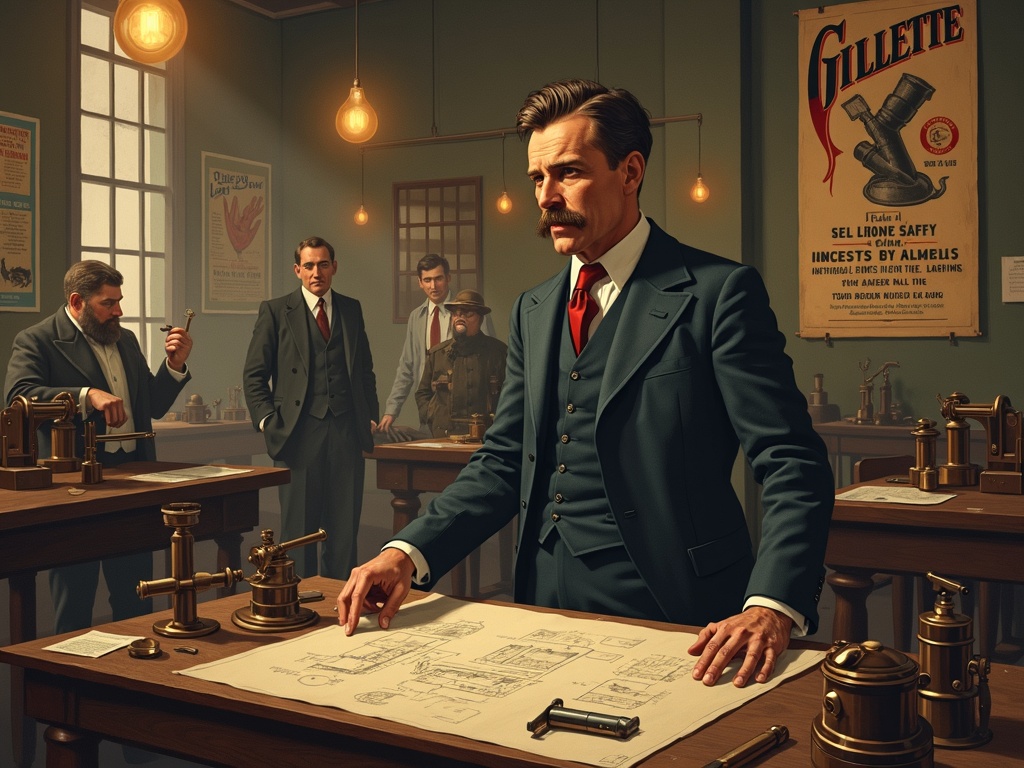
King Camp Gillette stands as the visionary founder behind the razor empire that bears his name today. This American inventor and salesman fundamentally transformed personal grooming through his groundbreaking approach to shaving technology. His journey began in 1895 when inspiration struck for what would become one of the most significant innovations in men’s grooming history.
The concept that would revolutionize shaving centered around a simple yet brilliant idea: creating a disposable razor blade that men could use and discard. Before Gillette’s innovation, men relied on dangerous straight razors that required constant maintenance and posed significant safety risks during daily use. It is remarkable how Gillette recognized this market gap and pursued a solution that would benefit millions of men worldwide.
Gillette’s breakthrough involved developing a thin, inexpensive steel blade that could be sharpened mechanically and thrown away after several uses. This innovation eliminated the need for men to maintain their own razor blades or visit barbers regularly for shaving services. The disposable nature of these blades represented a complete departure from traditional shaving methods and created an entirely new business model.
Engineering Partnership That Changed Everything
Recognizing that his vision required technical expertise beyond his own capabilities, Gillette partnered with William Emery Nickerson, an MIT-trained machinist who possessed the engineering skills necessary to bring the concept to life. Their collaboration proved essential in developing the first mass-produced safety razor that could reliably hold and position the thin disposable blades.
Nickerson’s engineering expertise complemented Gillette’s entrepreneurial vision perfectly. Together, they solved numerous technical challenges related to blade manufacturing, holder design, and mass production processes. The partnership demonstrates how innovation often requires combining visionary thinking with practical engineering skills.
The culmination of their efforts resulted in U.S. Patent No. 775,134, granted on November 15, 1904, for the Gillette safety razor. This patent protected their revolutionary design and established the foundation for what would become a global shaving empire. The timing proved perfect as the patent coincided with growing demand for more convenient personal grooming solutions.
Gillette’s invention fundamentally changed shaving practices by offering a safer, more convenient alternative to straight razors. Men no longer needed to worry about accidentally cutting themselves during their daily routine, and the convenience factor made regular shaving more accessible. The safety razor design featured protective guards that positioned the blade at the optimal angle while preventing direct skin contact with the sharp edge.
The impact of King Camp Gillette’s innovation extends far beyond personal convenience. His business model of selling razors at low cost while generating profits from replacement blades became known as the “razor and blade” model. This approach has since been adopted by countless industries, from printers and ink cartridges to gaming consoles and software.
Modern Gillette razor manufacturing continues to build upon the foundation that King Camp Gillette established over a century ago. The company has expanded globally, with manufacturing facilities producing millions of razors annually to meet worldwide demand.
Today’s Gillette wholesale operations serve distributors across continents, maintaining the legacy of innovation that began with one man’s vision for better shaving. The brand continues evolving through advanced blade technologies, ergonomic handle designs, and specialized products for different market segments.
King Camp Gillette’s legacy lives on through every safety razor used today. His combination of practical innovation and business acumen created not just a successful company, but an entire industry built around disposable blade technology that continues shaping modern grooming habits worldwide.
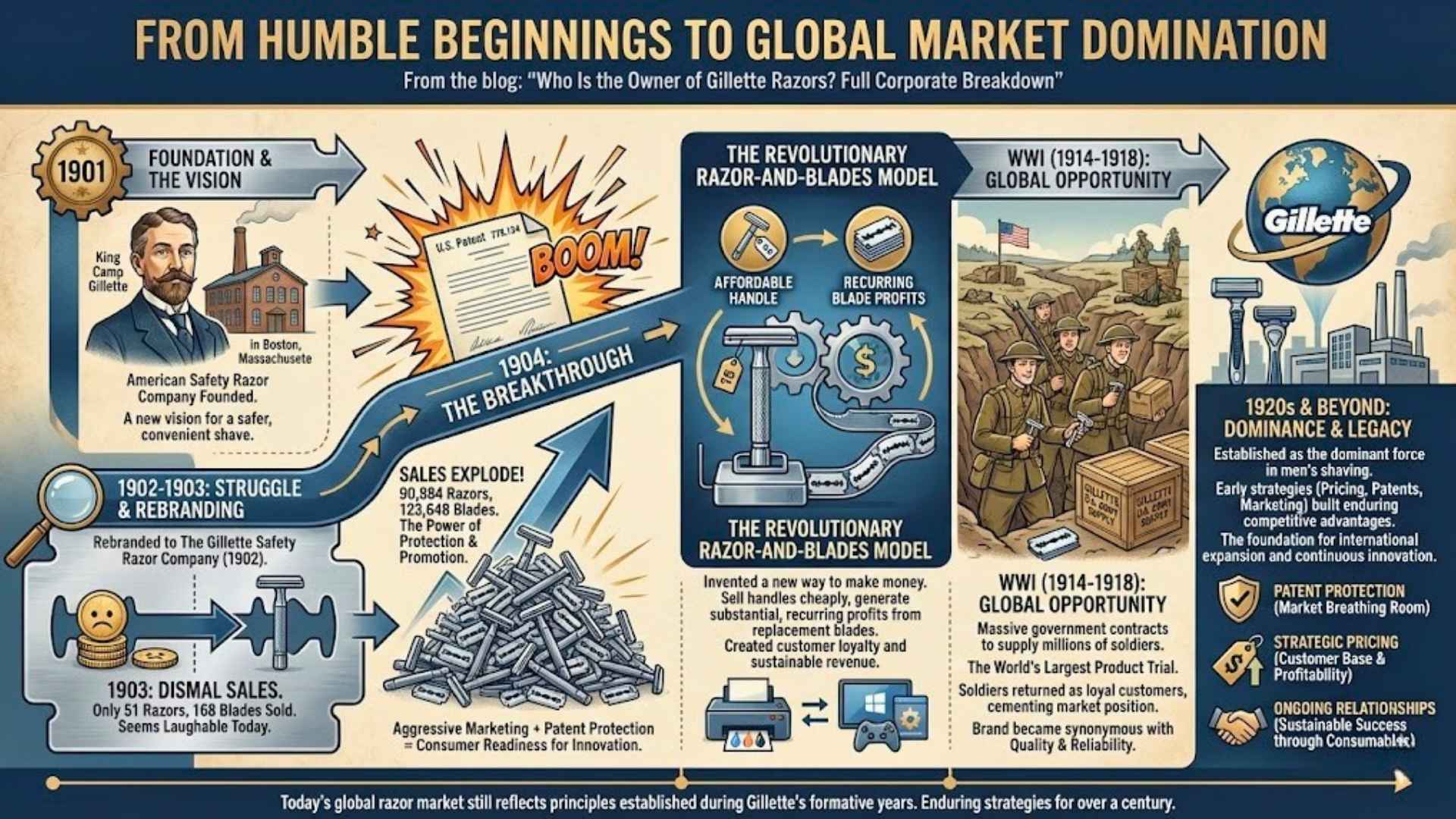
From Humble Beginnings to Global Market Domination
I find Gillette’s transformation from a small startup to a global powerhouse fascinating. The company launched in 1901 as the American Safety Razor Company in Boston, Massachusetts, marking the beginning of what would become one of the most recognizable brands in personal care.
Early Struggles and Strategic Rebranding
Just one year after its founding, the company rebranded itself as The Gillette Safety Razor Company in 1902. This change reflected King Camp Gillette’s vision for a safer, more convenient shaving experience. However, early sales figures tell a story of struggle rather than immediate success. The company managed to sell only 51 razors and 168 blades throughout 1903, numbers that would seem laughable by today’s standards.
Everything changed in 1904 when the company secured U.S. Patent 775,134 and launched aggressive marketing campaigns. Sales exploded to 90,884 razors and 123,648 blades, demonstrating the power of patent protection combined with effective promotion. This dramatic increase proved that consumers were ready for innovation in shaving technology.
Revolutionary Business Model That Changed Everything
Gillette didn’t just create a better razor; they invented an entirely new way to make money. The company pioneered what became known as the razor-and-blades business model. I consider this strategy brilliant in its simplicity:
- Sell razor handles at affordable prices
- Generate substantial profits from replacement blade sales
This approach created recurring revenue streams and built customer loyalty. Once someone owned a Gillette handle, they needed Gillette blades. The model became so successful that countless industries adopted variations of it, from printers and ink cartridges to gaming consoles and software.
World War I provided Gillette with an unexpected opportunity that would cement its market position permanently. The company secured contracts to supply razors to millions of American soldiers heading overseas. This massive distribution created an entire generation of loyal customers who returned home already familiar with and committed to the Gillette brand.
The war essentially served as the world’s largest product trial, introducing Gillette razors to men who might never have encountered them otherwise. Soldiers appreciated the convenience and safety compared to traditional straight razors, especially in challenging battlefield conditions. When these servicemen returned to civilian life, they continued purchasing Gillette products and recommended them to friends and family.
This period established Gillette as more than just another razor company. The brand became synonymous with quality, innovation, and reliability. The company’s ability to scale production rapidly during wartime also demonstrated operational capabilities that would serve it well in peacetime markets.
Understanding where Gillette razors are made today reveals how this early foundation led to global manufacturing networks. The company’s early success with the razor-and-blades model created the financial resources necessary for international expansion and continuous product innovation.
By the 1920s, Gillette had established itself as the dominant force in men’s shaving. The company’s early decisions regarding pricing strategy, patent protection, and marketing created competitive advantages that persist today. The foundation built during those first two decades enabled Gillette to withstand economic downturns, adapt to changing consumer preferences, and maintain market leadership through multiple generations.
The lessons from Gillette’s early years remain relevant for modern businesses:
- Patent protection provided crucial breathing room for market development
- Strategic pricing built customer bases while ensuring profitability
- Building ongoing relationships with customers through consumable products created sustainable success
Today’s global razor market still reflects principles established during Gillette’s formative years, proving that sound business strategies can endure for more than a century.
How Gillette Maintains Global Leadership in the Grooming Industry
Under P&G’s ownership, Gillette serves as the flagship brand within the company’s Grooming segment, commanding an impressive portfolio that extends far beyond basic razors. The comprehensive product ecosystem demonstrates P&G’s strategic approach to dominating every corner of the grooming market.
Gillette’s Comprehensive Product Portfolio
P&G has structured Gillette’s offerings across multiple categories to capture diverse consumer needs:
- Men’s blades and razors featuring premium lines like Fusion5, ProGlide, SkinGuard, and the classic Mach3
- Women’s shaving solutions under the Venus brand umbrella
- Electric grooming tools through the Braun acquisition
- Premium grooming experiences via The Art of Shaving
This tiered brand strategy allows P&G to target different demographics and price levels effectively. I’ve observed how this approach enables the company to maintain market presence from budget-conscious consumers to luxury grooming enthusiasts.
Gillette still holds over 50% of the global razor and blades market, a testament to P&G’s strategic stewardship. Competition from Dollar Shave Club and Harry’s has certainly challenged traditional pricing models and distribution methods. However, Gillette’s dominance persists due to several key advantages that P&G has carefully cultivated.
High R&D investment remains central to Gillette’s competitive edge. P&G consistently allocates substantial resources to developing cutting-edge shaving technologies, ensuring Gillette razors stay ahead of emerging competitors. Patented shaving technologies create barriers to entry that protect market position while delivering genuine performance benefits to consumers.
P&G’s global retail presence gives Gillette unmatched distribution advantages. The company’s established relationships with major retailers across multiple continents ensure product availability in virtually every market where consumers purchase grooming products. This extensive network complements wholesale operations that serve smaller retailers and emerging markets.
Strong brand equity, built over more than a century and reinforced through P&G’s marketing expertise, continues to drive consumer preference. Innovations such as FlexBall technology, 5-blade cartridges, and advanced lubrication enhancements keep Gillette competitive against both traditional competitors and direct-to-consumer challengers.
P&G’s investment in manufacturing capabilities across multiple regions ensures consistent quality while optimizing supply chain efficiency. This global production network supports both domestic markets and export operations, maintaining Gillette’s position as the world’s leading shaving brand under P&G’s continued ownership.
Sources:
Procter & Gamble: 2023 Annual Report
The New York Times: “Procter & Gamble Buys Gillette”
Harvard Business School: “Finding New Play in a Commoditized Market”
Associated Press: “Buffett Calls P&G–Gillette Deal a ‘Dream’”
U.S. Patent and Trademark Office: Patent No. 775,134

