
No products in the cart.
Beverages News, Schweppes, Soft Drinks
What Is Schweppes? The Journey Of A Global Brand
04
Jan
Jan
Johann Jacob Schweppe transformed the beverage industry in 1783 by developing the first commercial method for producing stable, bottled carbonated water. His innovation grew from a German watchmaker’s laboratory experiment into a global brand that would earn Royal Warrants and define premium mixer categories. The Schweppes journey represents over 240 years of continuous innovation, strategic expansion from Geneva to London to worldwide markets, and successful adaptation from medicinal soda water to essential cocktail mixers that shaped modern drinking culture.
Table of Contents
Key Takeaways
- Innovative Origins: Founded in 1783 by German watchmaker Johann Jacob Schweppe, who used his precision engineering skills to solve the challenge of commercially bottling stable carbonated water
- Royal Recognition and Premium Positioning: Earned Royal Warrants from British monarchs starting with King William IV in the 1830s, establishing the brand as a symbol of quality and sophistication
- Global Expansion Strategy: Successfully expanded from Geneva to London in 1792, then worldwide through strategic manufacturing facilities and distribution networks across the British Empire
- Cocktail Culture Pioneer: Created iconic mixers including tonic water (1870s), ginger ale, and bitter lemon that became essential ingredients defining modern cocktail culture and bar standards
- Modern Market Leadership: Maintains strong brand recognition and consumer loyalty today through complex regional partnerships while focusing on premium carbonated mixers rather than competing directly with mainstream soft drinks
To explore more about the Schweppes legacy and products, visit the official Schweppes website.
How Johann Jacob Schweppe Revolutionized Beverages in 1783
I’ll take you back to 1783, when a German-born watchmaker named Johann Jacob Schweppe changed the beverage industry forever. Working from his base in Geneva, Switzerland, Schweppe combined his precision engineering skills with amateur scientific pursuits to solve a problem that had puzzled many before him: how to create stable, bottled carbonated water on a commercial scale.
From Laboratory Experiment to Commercial Success
Schweppe built upon groundbreaking research by English chemist Joseph Priestley, who had discovered methods for infusing water with carbon dioxide. However, Priestley’s work remained largely confined to laboratory settings. Schweppe’s watchmaking background proved crucial here – his understanding of precise mechanical processes allowed him to develop an industrial system that could bottle carbonated mineral water reliably and efficiently.
The innovation wasn’t just technical; it was cultural. Early Schweppes beverages weren’t marketed as sweet refreshments but as health-oriented soda water. This positioning tapped into the era’s growing fascination with mineral springs and their supposed medicinal benefits. The expanding middle class, increasingly health-conscious and with disposable income, became Schweppe’s primary target market.
Schweppe’s timing proved exceptional. By 1792, he recognized that Geneva’s location, while suitable for initial operations, limited his growth potential. His decision to relocate to London represented a strategic masterstroke that would define the company’s future. London wasn’t just Britain’s capital – it sat at the center of the expanding British Empire, with trade routes stretching across continents.
This move positioned Schweppe’s operation to capitalize on global distribution networks that few other beverage companies could access. The British Empire’s vast reach meant that Schweppes’ story could spread far beyond European borders, laying groundwork for what would become international brand recognition.
Schweppe’s approach was particularly clever because he didn’t just create a product – he established an entirely new product category. Before 1783, carbonated beverages existed primarily as natural mineral waters found at specific geographic locations. Schweppe’s process democratized carbonation, making it available anywhere his bottles could reach.
The technical achievement can’t be understated. Creating stable carbonated water required solving multiple challenges:
- Maintaining consistent carbonation levels
- Preventing contamination
- Ensuring bottles wouldn’t explode during transport
Schweppe’s watchmaker precision proved invaluable in developing equipment that could handle these demands reliably.
His emphasis on health positioning also reflected shrewd market understanding. Rather than competing with established alcoholic beverages or simple water, Schweppe created a premium category that justified higher prices while appealing to contemporary wellness trends. This strategy established patterns that Schweppes continues to follow today.
The 1792 London relocation marked more than geographic expansion – it represented transformation from Swiss startup to potential global enterprise. London’s commercial infrastructure, established shipping networks, and growing consumer base provided exactly what Schweppe needed to scale his operation.
Schweppe’s revolution wasn’t just about carbonation technology; it was about recognizing how to transform scientific discovery into mass-market appeal. His combination of technical innovation, strategic positioning, and geographic expansion created a template that countless beverage companies would later follow. The foundation he laid in 1783 continues to influence how we think about carbonated beverages today, proving that some innovations truly do stand the test of time.
From Royal Warrant to Premium British Institution
I find it fascinating how Schweppes transformed from a German inventor’s medicinal water into Britain’s most prestigious beverage brand. After Johann Jacob Schweppe moved his operations to Britain, he established the company’s first factory in London’s Drury Lane during the early 1790s. This strategic location placed Schweppes at the center of British commerce and society.
The brand’s elevation to premium status came through royal recognition in the 1830s when King William IV granted Schweppes a Royal Warrant. This prestigious endorsement wasn’t just ceremonial – it represented the Crown’s official approval of the brand’s quality and reliability. Queen Victoria later renewed this warrant, and subsequent monarchs continued to recognize Schweppes, cementing its position as the carbonated beverage of choice for British royalty.
Royal endorsement didn’t just validate the product’s quality; it transformed Schweppes into a symbol of refinement and social status. The Schweppes brand story became intertwined with British high society, where serving Schweppes at prestigious events demonstrated sophistication and adherence to the highest standards. The association with Malvern mineral water further enhanced this upmarket positioning, as Malvern was already recognized as a premium water source favored by the elite.
Innovation Beyond Basic Soda Water
During the 19th century, I observe that Schweppes didn’t rest on its royal laurels but continued expanding its product portfolio. The company moved beyond simple soda water, introducing artificial seltzer water that maintained the same quality standards but offered greater consistency. Early aerated lemonade represented another significant innovation, bringing flavored carbonation to market well before competitors recognized this opportunity.
By the mid-1800s, Schweppes had already begun selling flavored carbonated drinks, departing from the purely medicinal-style mineral waters that dominated the market. This innovation positioned the brand as a pioneer in what would become the modern soft drink industry. The company’s ability to evolve from medicinal waters to pleasurable beverages while maintaining its premium reputation demonstrates remarkable business acumen.
The tonic water legacy that emerged during this period exemplifies how Schweppes balanced innovation with quality. Rather than simply following market trends, the company created new product categories that would define British beverage culture for generations.
This foundation of royal approval, continuous innovation, and premium positioning established Schweppes as more than just another beverage company. It became a British institution that represented quality, tradition, and sophistication – values that continue to define what Schweppes represents today.
The transformation from a small German operation to a Royal Warrant holder illustrates how strategic positioning, quality maintenance, and market innovation can elevate a brand beyond mere commercial success. Schweppes didn’t just sell carbonated water; it sold prestige, reliability, and a connection to British heritage that resonated with consumers across all social classes who aspired to the quality standards of the royal court.
The Creation of Iconic Mixers That Defined Cocktail Culture
I consider Schweppes one of the most influential forces in cocktail culture development, primarily through their revolutionary carbonated beverages that transformed how people mixed and enjoyed drinks. The brand’s innovation began with fizzy lemonade in the 1830s, which established the foundation for flavored soft drinks and mixers that would change drinking habits across the globe.
Pioneering Carbonated Mixers for the Modern Bar
Around 1870, Schweppes introduced one of the first commercial carbonated tonic waters, originally designed to carry quinine for medicinal purposes. This innovation proved transformative when bartenders discovered its perfect compatibility with gin, creating the classic gin and tonic that became a cornerstone of cocktail culture. Schweppes tonic water legacy continues to influence modern mixology practices.
Ginger ale followed in the late 19th century, offering bartenders and home enthusiasts a zesty, lightly spicy mixer that paired exceptionally well with spirits and punches. This carbonated ginger beverage filled a crucial gap in the mixer market, providing the perfect balance of sweetness and spice that complemented various alcoholic beverages without overpowering their distinct flavors.
The introduction of Bitter Lemon in 1957 marked another significant milestone in mixer evolution. This tart, complex citrus mixer quickly became a bar staple across Europe and former British territories, adding sophisticated depth to cocktails and establishing new drinking traditions in regions where Schweppes brand story had already taken root.
Modern Flagship Products Shaping Today’s Cocktail Scene
Today’s Schweppes portfolio includes several flagship products that continue defining cocktail culture. The lineup features these essential mixers:
- Schweppes Indian Tonic Water – the premium option with enhanced botanical complexity
- Schweppes Tonic Water – the classic formula that established the gin and tonic tradition
- Schweppes Ginger Ale – the versatile spicy mixer for countless cocktail combinations
- Schweppes Bitter Lemon – the sophisticated citrus option for discerning palates
- Schweppes Lemonade – the sweet, refreshing base for lighter mixed drinks
- Various region-specific mixers – customized flavors that cater to local taste preferences
Each product serves distinct roles in modern cocktail preparation, from classic mixer applications to contemporary craft cocktail innovations. Professional bartenders consistently rely on these carbonated beverages because they maintain consistent flavor profiles and carbonation levels that enhance rather than compromise the spirits they accompany.
I’ve observed how Schweppes products bridge traditional cocktail culture with modern drinking trends. The legacy of sparkling drinks continues through these mixers, which adapt to changing consumer preferences while maintaining the quality standards that established their reputation. The brand’s commitment to carbonation excellence ensures each mixer delivers the perfect effervescence that elevates cocktail experiences.
The success of these iconic mixers stems from their ability to complement rather than compete with premium spirits. Schweppes’ timeless appeal lies in understanding that great mixers enhance the drinking experience without overwhelming the primary flavors. This philosophy shaped cocktail culture by encouraging experimentation while maintaining drink quality standards that both professional bartenders and home enthusiasts could depend on consistently.
Worldwide Expansion Through Manufacturing and Corporate Evolution
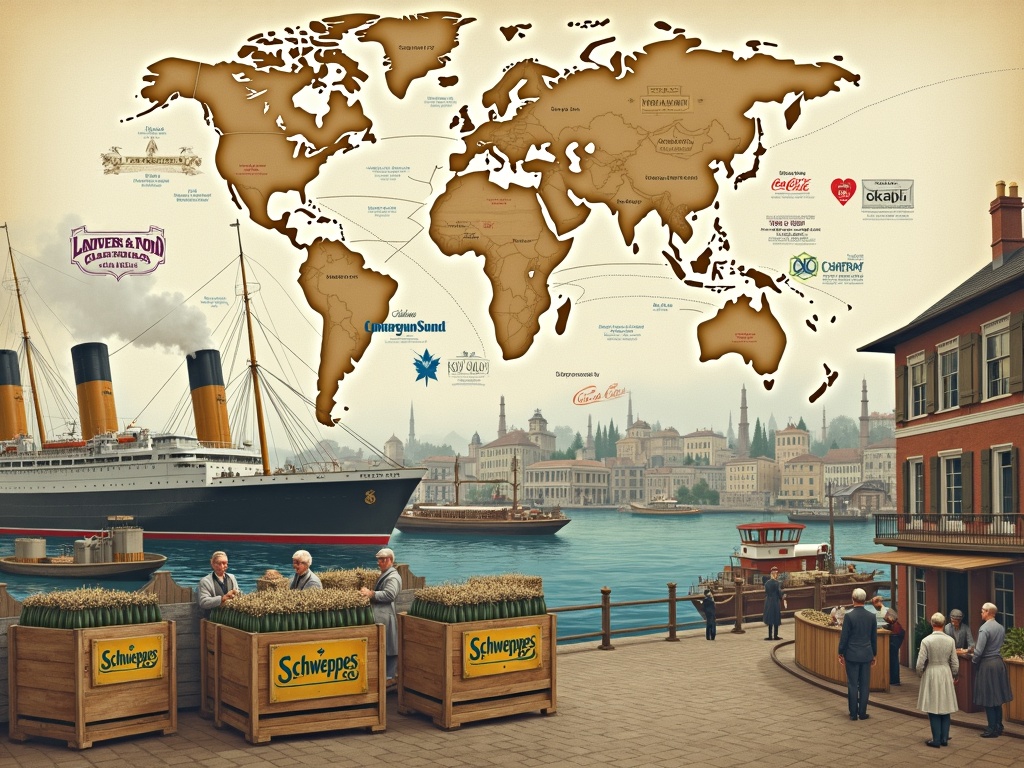
By the mid-19th century, Schweppes had transformed from a local London operation into a global enterprise. The company shipped its products worldwide in distinctive torpedo-shaped bottles, carefully packed in straw for protection during lengthy sea voyages. These uniquely designed bottles couldn’t stand upright, which served a clever purpose—keeping the cork moist and maintaining carbonation levels throughout extended transportation periods.
Establishing International Manufacturing Presence
Schweppes didn’t merely export products; the company established manufacturing operations in strategic locations. I can trace the brand’s international expansion to 1878 when Schweppes opened its first Australian factory in Sydney. The company quickly followed this success by establishing a second plant in Melbourne during the early 1880s, firmly anchoring its presence throughout the Southern Hemisphere. This tonic water legacy demonstrated the brand’s commitment to serving global markets with locally produced beverages.
Corporate Growth Through Strategic Acquisitions
Schweppes became a public company in 1897, providing the capital foundation for aggressive expansion through acquisitions. The company’s growth strategy included purchasing complementary brands that expanded its product portfolio beyond carbonated beverages.
Notable acquisitions included:
- L. Rose & Co. in 1957, known for lime juice products
- Chivers and Sons in 1959, a producer of jams
- William P. Hartley in 1959, another jam manufacturer
The most significant corporate transformation occurred in 1969 when Schweppes merged with confectionery giant Cadbury. This merger created Cadbury Schweppes, combining soft drinks and confectionery under one corporate umbrella. The brand story took another turn through subsequent restructurings and demergers that fundamentally changed ownership structures.
Later corporate changes resulted in the Schweppes brand being licensed or sold into different corporate systems across various markets. In North America, the brand eventually became part of what is now Keurig Dr Pepper, while other regions saw licensing agreements with Coca-Cola bottlers. These changes reflect how major beverage brands adapt to regional market conditions while maintaining their core identity and product quality standards. Understanding who owns Schweppes today requires examining these complex corporate arrangements across different global markets.
Schweppes in Today’s Global Beverage Market
I’ve witnessed the soft drinks industry’s impressive expansion firsthand, with the global market reaching over USD 400 billion in the early 2020s. This massive industry continues growing at approximately 5% compound annual growth, driven by consumer demand for both traditional and innovative beverage options.
The Premium Mixer Revolution
Carbonated soft drinks dominate a substantial portion of this market, but I’ve noticed something particularly interesting happening within the mixer and tonic water segment. These categories represent a growing premium niche that’s capturing consumer attention and wallet share. Industry reports indicate that tonic water alone could approach USD 2 billion in annual global sales by the decade’s end, reflecting consumers’ willingness to pay more for quality mixers.
The Schweppes tonic water legacy positions the brand perfectly within this expanding premium space. I see consumers increasingly treating mixers as essential components of their drinking experience rather than afterthoughts.
Competitive Landscape and Market Position
Schweppes’ legacy gives it significant advantages in today’s competitive environment. The brand faces stiff competition from several key players:
- Fever-Tree, which has carved out the super-premium segment with artisanal positioning
- Canada Dry, another heritage brand with strong North American presence
- Numerous local and regional labels that compete on price and local taste preferences
- Emerging craft mixer brands targeting health-conscious consumers
What makes Schweppes’ market position particularly complex is its licensing structure across different regions. Different owners in various territories mean that exact market share and revenue figures vary significantly by geography. This fragmented ownership structure affects how I analyze the brand’s global performance.
Despite these ownership complexities, I consistently observe Schweppes maintaining strong market presence across dozens of countries. The brand often serves as the “default” choice for tonic water and ginger ale in bars, hotels, and retail chains worldwide. This positioning reflects both brand recognition and distribution strength that many competitors struggle to match.
Schweppes’ brand story resonates with consumers who value heritage and reliability in their mixer choices. I find that this historical credibility becomes increasingly valuable as the market grows more crowded with new entrants. The brand’s ability to maintain relevance while honoring its carbonation heritage demonstrates adaptive strength that many legacy brands lack.
Brand Strength, Digital Presence, and Consumer Loyalty
Modern brand tracking confirms that Schweppes maintains its position as a highly recognized heritage brand with remarkable staying power. I’ve observed how the brand consistently delivers strong performance metrics across multiple market research studies, demonstrating its enduring appeal to consumers.
Market Recognition and Performance Metrics
Recent Savanta BrandVue Drinks report findings in the UK reveal Schweppes’ impressive trajectory, showing a sharp rise in overall brand ranking alongside strong Net Promoter Score performance. These metrics indicate that consumers don’t just recognize the brand—they actively recommend it to others. Awareness levels in critical markets like the US and UK remain exceptionally high, with a substantial share of soft drink consumers familiar with Schweppes’ legacy.
Among consumers who know the brand, many report strong likelihood of repeat purchase, particularly for mixer categories including tonic water, ginger ale, and club soda. This loyalty stems from decades of consistent quality and the brand’s unique positioning in both everyday consumption and special occasions. The data shows that once consumers try Schweppes products, they tend to return, creating a reliable customer base that supports long-term growth.
Digital Commerce and Product Availability
Digital shelf data and e-commerce listings demonstrate Schweppes’ comprehensive market presence across diverse pack formats. I notice the brand strategically offers products in multiple sizes to meet varying consumer needs:
- 150–330 ml cans for individual consumption and convenience
- 1–1.5 L PET bottles for family use and value-conscious shoppers
- Multi-pack cases designed for retail and HoReCa (Hotel, Restaurant, Café) channels
- Premium glass bottles for upscale establishments and gift occasions
- Variety packs combining different flavors for experimental consumers
This extensive format range ensures Schweppes captures sales across different consumption occasions, from quick personal refreshment to large gatherings and professional food service operations. The brand’s digital presence spans major e-commerce platforms, grocery delivery services, and specialized beverage retailers, making it accessible to consumers regardless of their preferred shopping method.
The combination of Schweppes’ long history, royal associations, and continued relevance in modern cocktail culture supports what I consider its “modern classic” image. This positioning allows the brand to attract both traditional consumers who appreciate its heritage and younger demographics drawn to craft cocktail trends. Schweppes’ timeless appeal bridges generational gaps, creating a unique market position that few beverage brands achieve.
Digital marketing initiatives focus on cocktail education, recipe sharing, and partnership with premium spirits brands, reinforcing Schweppes’ status as an essential mixer. Social media presence emphasizes sophistication and quality, targeting both home bartenders and professional mixologists who influence consumer preferences in the hospitality industry.
The brand’s strength also comes from its ability to maintain premium positioning while remaining accessible. Classic mixer products like tonic water command higher margins than standard soft drinks, yet consumers willingly pay the premium because they associate Schweppes with superior taste and mixing performance. This pricing power, combined with efficient distribution and strong retailer relationships, creates a sustainable competitive advantage that newer beverage brands struggle to replicate.
Consumer loyalty extends beyond repeat purchases to brand advocacy, with many users specifically requesting Schweppes by name when ordering drinks or shopping for mixers. This brand preference translates into valuable shelf space allocation from retailers and prominent placement in bars and restaurants, further reinforcing the brand’s market position and accessibility to new consumers.
What is Schweppes Today? A Heritage Mixer in Modern Hands
I see Schweppes today as a fascinating example of how a centuries-old brand adapts to modern markets while maintaining its core identity. At its heart, Schweppes represents 240 years of beverage innovation, built on a foundation that began with Jacob Schweppe’s pioneering work in carbonated water production.
The Modern Schweppes Portfolio
Today’s Schweppes lineup centers around premium carbonated mixers that have become essential ingredients in both professional bars and home cocktail setups. I find their product range strategically focused on elevated drinking experiences rather than competing directly with mainstream sodas. Their signature offerings include several key products:
- Tonic Water remains their flagship product, featuring that distinctive quinine bite that transforms a simple gin into a proper G&T.
- Ginger Ale delivers the spicy warmth that complements whiskey-based cocktails perfectly.
- Lemonade provides a sophisticated citrus base for various mixed drinks.
- Bitter Lemon offers a unique flavor profile that works exceptionally well with vodka and premium spirits.
Each product maintains consistent quality standards across different markets, despite the complex ownership structure that governs the brand today.
Corporate Structure and Global Reach
I observe that Schweppes ownership operates through a complex web of regional partnerships rather than a single corporate entity. Different beverage giants handle distribution and production across various territories — Coca-Cola bottlers manage operations in some regions, while Keurig Dr Pepper and Asahi control other markets. This fragmented approach might seem chaotic, but it actually allows Schweppes to leverage each partner’s local expertise and distribution networks.
Despite these varied ownership arrangements, I notice that Schweppes maintains remarkable consistency in brand positioning across markets. Every regional partner understands that Schweppes represents premium quality and heritage, not budget alternatives to major soft drink brands.
The brand’s current strategy brilliantly positions it between two growing market segments:
- Traditional soft drinks are facing increasing health consciousness among consumers.
- Premium mixers and at-home cocktail culture continue expanding globally.
I see Schweppes capturing value from both trends by offering products that work as sophisticated standalone beverages or essential cocktail components.
Modern consumers appreciate Schweppes tonic water and other mixers because they deliver authentic flavors developed over centuries of refinement. The brand doesn’t chase every flavor trend or launch dozens of variants annually. Instead, it focuses on perfecting core products that bartenders and home enthusiasts rely on consistently.
I find this approach particularly smart given today’s cocktail renaissance. As more people invest in quality spirits for home bars, they naturally seek premium mixers that won’t compromise their expensive gin or whiskey. Schweppes’ legacy provides exactly the credibility and quality assurance these consumers want.
The brand’s heritage becomes a competitive advantage in an era where authenticity matters more than ever. While newer mixer brands might offer trendy flavors or eye-catching packaging, Schweppes offers something harder to replicate: genuine tradition backed by consistent quality. This positioning allows the brand to command premium pricing while maintaining broad appeal across different age groups and drinking occasions.
Today’s Schweppes successfully bridges multiple consumer needs — from those seeking sophisticated non-alcoholic options to serious cocktail enthusiasts requiring reliable mixing ingredients. The brand’s timeless appeal continues attracting new generations while satisfying longtime customers who remember when Schweppes first introduced them to premium carbonated beverages.
https://www.youtube.com/shorts/HQsCueBIOmc
Sources:
Savanta BrandVue Drinks

