
No products in the cart.
Beverages News, Soft Drinks, Sprite Carbonated Soft Drinks
Who Makes Sprite Global Production Revealed
11
Dec
Dec
The Coca-Cola Company owns and governs the global brand of Sprite, while utilising a massive, interconnected bottling system that ensures local efficiency and worldwide consistency.
Table of Contents
Key Takeaways
- The Coca-Cola Company owns the Sprite trademark, original formula, and maintains complete control over brand strategy. Sprite generates over $1 billion in annual retail sales, placing it in Coca-Cola’s exclusive billion-dollar brand portfolio.
- Physical production is performed by major regional bottlers such as Coca-Cola Europacific Partners (Europe/Asia-Pacific), Coca-Cola FEMSA (Latin America), and Coca-Cola HBC (Eastern Europe/Africa). These companies operate under strict licensing agreements with Coca-Cola.
- Sprite commands about 8% of the U.S. carbonated soft drink market by volume, making it the third most popular soda after Coca-Cola and Dr Pepper. It also stands as the world’s leading lemon-lime flavored beverage.
- Local production facilities combine Coca-Cola’s proprietary concentrate with locally sourced water and other approved ingredients. This ensures product freshness and consistent taste regardless of region.
- The franchised bottling system facilitates Sprite’s global distribution in over 200 countries. Bottling partners adapt packaging and production to reflect local preferences and meet seasonal demand.
For more information on Sprite’s global reach and bottling operations, visit the official Coca-Cola Sprite brand page.
The Coca-Cola Company Owns and Controls the Global Sprite Brand
The Coca-Cola Company stands as the sole owner of the Sprite brand, having created and launched this iconic lemon-lime soda in the early 1960s. I’ve seen how this beverage giant maintains complete control over Sprite’s development from its original formula to its current global brand strategy. The company holds the trademark rights and oversees every aspect of Sprite’s international presence.
Sprite occupies a premium position within Coca-Cola’s sparkling soft drink portfolio, earning recognition as the world’s leading lemon-lime flavored beverage. The brand has achieved remarkable commercial success, joining Coca-Cola’s exclusive billion-dollar club with estimated annual retail sales exceeding USD 1 billion. This puts Sprite alongside other flagship names like Coca-Cola Classic and Fanta in the company’s top-tier brands.
Sprite’s Market Position and Corporate Scale
Coca-Cola often positions Sprite as its second-best-selling global soft drink across many markets, trailing only behind Coca-Cola Classic. This impressive ranking demonstrates the brand’s massive reach and consumer appeal worldwide. The corporate scale supporting Sprite’s operations becomes clear when considering The Coca-Cola Company’s revenue of approximately USD 47 billion in trailing twelve months for 2024-2025.
Understanding who makes Sprite requires recognizing two distinct operational layers:
- The brand owner and recipe holder: The Coca-Cola Company maintains exclusive ownership of the Sprite trademark, original formula, and strategic direction.
- Local bottlers: Independent companies manufacture, package, and distribute Sprite products in their respective markets under Coca-Cola’s licensing agreements.
This dual structure allows Coca-Cola to maintain brand consistency while leveraging local expertise for production and distribution. The company’s extensive network of bottling partners enables Sprite to reach consumers across virtually every global market. Each bottler operates according to strict quality standards and specifications set by The Coca-Cola Company, ensuring that Sprite’s taste profile remains consistent regardless of where you purchase it.
The Coca-Cola Company’s ownership of Sprite extends beyond simple brand management. They control product innovation, marketing campaigns, packaging design, and strategic partnerships that shape how consumers experience the brand globally. This comprehensive control has enabled Sprite to maintain its position as a market leader while adapting to regional preferences and changing consumer demands across different countries and cultures.

The Global Coca-Cola Bottling System Manufactures Sprite Worldwide
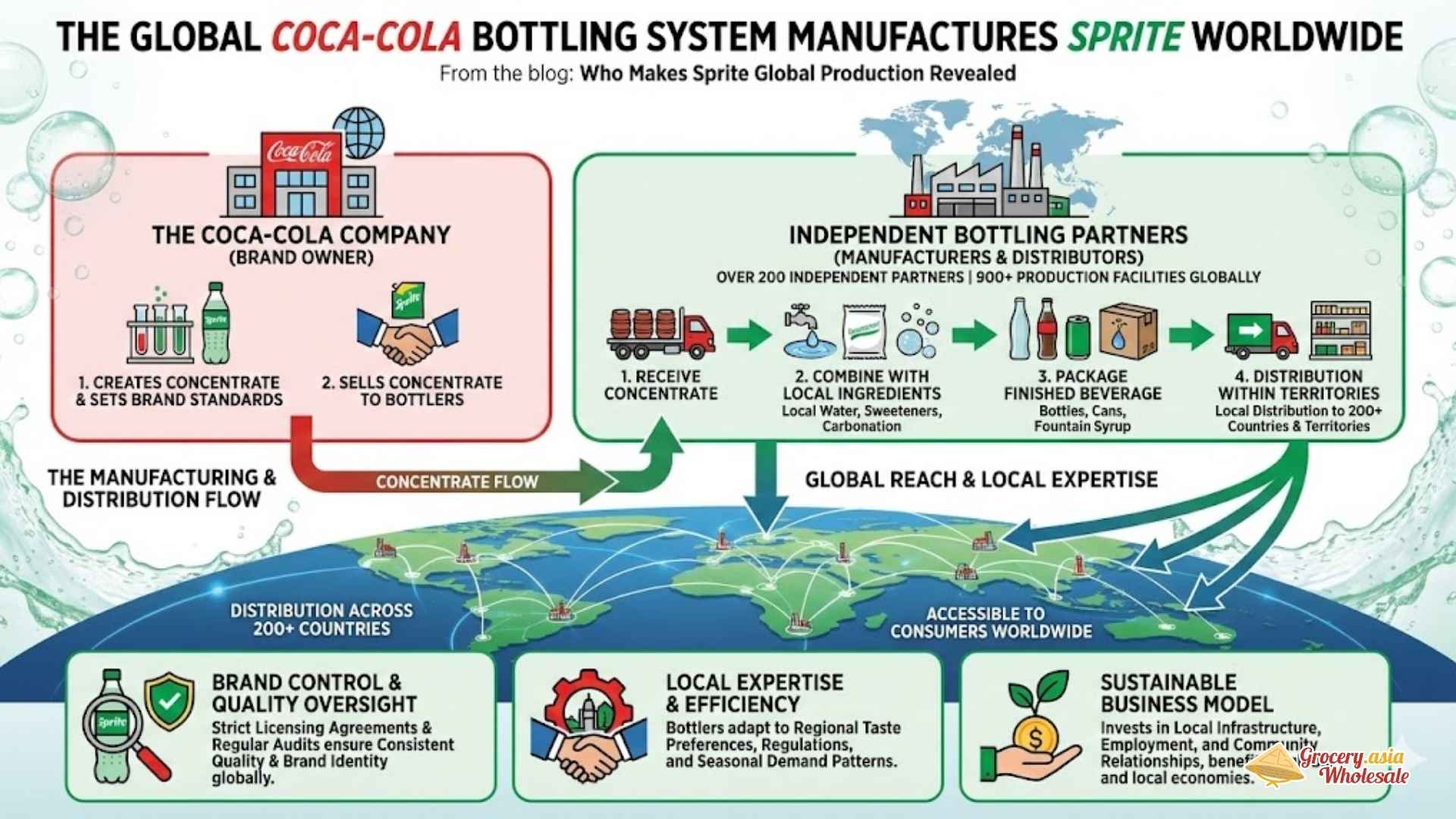
I’ll explain how The Coca-Cola Company utilizes a sophisticated franchised bottling system rather than handling Sprite production internally. This extensive network operates through more than 200 independent bottling partners who manage over 900 production facilities across the globe to manufacture Sprite and other Coca-Cola products.
The process begins with The Coca-Cola Company creating Sprite concentrate and establishing strict brand standards. These concentrates get sold to authorized bottling partners who handle the actual manufacturing process. Each bottler combines the concentrate with local water sources, appropriate sweeteners, and carbonation to create the finished beverage. After mixing, they package Sprite into various formats including bottles, cans, and fountain syrup for distribution within their designated territories.
Production Scale and Global Reach
This franchised approach enables Sprite distribution across more than 200 countries and territories, establishing it as one of the most geographically widespread soft drinks available. The system’s reach makes Sprite accessible to consumers worldwide while maintaining consistent quality standards.
The bottling partners bring crucial local expertise to the manufacturing process. They understand regional taste preferences, regulatory requirements, and distribution channels that would be challenging for a single centralized operation to manage effectively. Each facility adapts production schedules and packaging formats to meet local demand patterns and seasonal variations.
This model provides The Coca-Cola Company with tight brand control while leveraging regional specialists for manufacturing efficiency. Bottlers invest in local infrastructure, employment, and community relationships, creating a sustainable business model that benefits both the global brand and local economies. The company maintains quality oversight through regular audits and standardized procedures while allowing bottlers flexibility in operational decisions.
Each bottling partner operates under strict licensing agreements that govern everything from ingredient sourcing to marketing approaches. This ensures that Sprite maintains its distinctive taste and brand identity regardless of production location, while allowing for necessary adaptations to local regulations and market conditions.
Major Regional Bottlers Produce Sprite Across the Globe
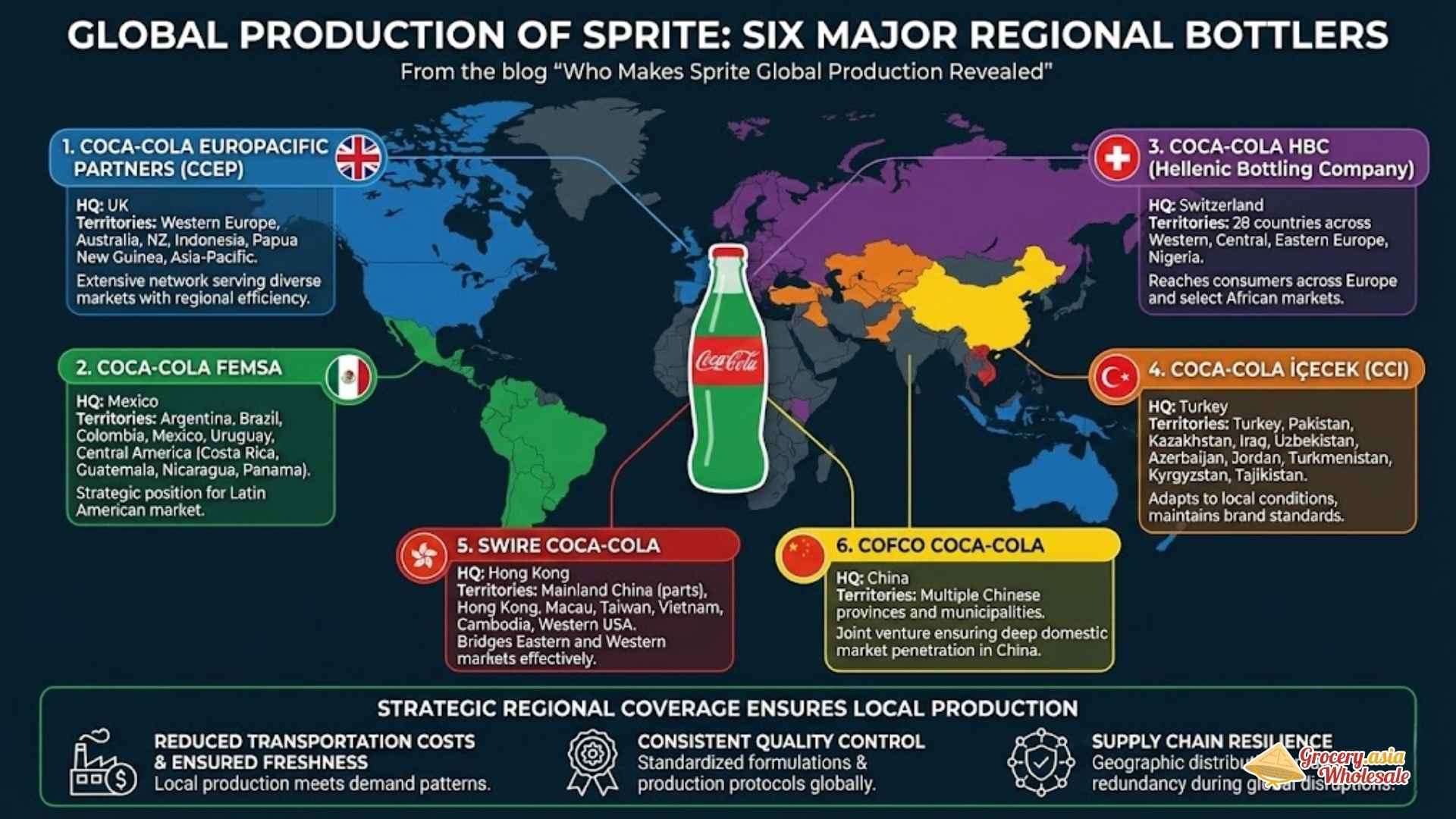
I’ve discovered that Sprite’s global production relies on six major regional bottling partners, each covering strategic geographic territories. These bottlers operate under license from The Coca-Cola Company, ensuring the lemon-lime soda maintains consistent taste and quality standards worldwide.
Coca-Cola Europacific Partners (CCEP) stands as one of the largest bottlers, headquartered in the UK and covering an impressive territory that spans Western Europe, Australia, New Zealand, Indonesia, Papua New Guinea, and parts of Asia-Pacific. This extensive network allows CCEP to serve diverse markets while maintaining regional efficiency in production and distribution.
Latin America falls under the jurisdiction of Coca-Cola FEMSA, based in Mexico. This bottler operates across Argentina, Brazil, Costa Rica, Guatemala, Nicaragua, Panama, Colombia, Mexico, and Uruguay, among other countries. FEMSA’s strategic positioning enables it to serve the growing Latin American market with locally produced Sprite beverages.
European operations extend beyond CCEP through Coca-Cola HBC (Hellenic Bottling Company), which operates from Switzerland. HBC covers 28 countries across Western, Central, and Eastern Europe, plus Nigeria in Africa. This bottler ensures that Sprite reaches consumers throughout the European continent and select African markets.
Strategic Regional Coverage Ensures Local Production
Coca-Cola İçecek (CCI), headquartered in Turkey, manages an extensive territory that includes Turkey, Pakistan, Kazakhstan, Iraq, Uzbekistan, Azerbaijan, Jordan, Turkmenistan, Kyrgyzstan, and Tajikistan. CCI’s reach into Central Asia and the Middle East demonstrates how regional bottlers adapt to local market conditions while maintaining brand standards.
Asian markets receive coverage through two primary bottlers:
- Swire Coca-Cola: Based in Hong Kong, operates in parts of mainland China, Hong Kong, Macau, Taiwan, Vietnam, Cambodia, and several U.S. states. This Hong Kong-based company bridges Eastern and Western markets effectively.
- COFCO Coca-Cola: A joint venture specifically focused on China, operates in multiple Chinese provinces and municipalities, ensuring domestic market penetration in one of the world’s largest beverage markets.
Each regional bottler brings distinct advantages to Sprite’s production network. Local production reduces transportation costs significantly while ensuring freshness. These bottlers understand their regional markets intimately, adapting production schedules to meet local demand patterns and seasonal variations.
Quality control remains consistent across all bottling operations through standardized formulations and production protocols established by The Coca-Cola Company. Regional bottlers must adhere to strict quality standards while leveraging their local expertise for distribution and marketing.
The geographic distribution of these bottlers creates redundancy and resilience in the supply chain. If one region experiences disruptions, other bottlers can potentially support neighboring markets. This network structure has proven essential during global challenges that affect supply chains.
Production capacity varies among bottlers based on their territory size and market demand. CCEP and FEMSA handle some of the highest volumes due to their extensive geographic coverage and population density within their territories. Smaller regional bottlers like CCI focus on specialized markets with unique cultural preferences and consumption patterns.
These regional partnerships allow Coca-Cola to maintain global brand consistency while benefiting from local market knowledge and operational efficiency. Each bottler invests in modern production facilities and distribution networks tailored to their specific regions, ensuring that consumers receive fresh Sprite products regardless of their location worldwide.
Local Production Facilities Where Sprite Is Actually Made
I’ve discovered that Sprite’s production operates through an extensive network of regional manufacturing facilities, bringing this iconic lemon-lime soda much closer to your local store than you might expect. Sprite’s production follows a decentralized model where authorized bottling partners create the beverage using Coca-Cola’s standardized formula while operating independently in their designated territories.
Regional Manufacturing Examples Across Different Markets
Great Britain demonstrates this localized approach perfectly, where Coca-Cola Europacific Partners operates multiple manufacturing sites dedicated to producing Sprite and other beverages. These facilities include locations in Sidcup, Edmonton, Milton Keynes, Wakefield, Morpeth, and East Kilbride. CCEP reports that roughly 97% of its products sold in Great Britain are made domestically, including Sprite, with more than 4 billion bottles and cans sold each year across the Coca-Cola portfolio.
Poland showcases another excellent example of regional production capabilities. Coca-Cola HBC’s Radzymin plant runs multiple production lines that manufacture all major sparkling drinks, including Sprite’s sleek formulation. This facility also produces PET preforms for plants across the country, demonstrating the integrated supply chain approach. Additionally, the Staniątki plant in Poland operates several lines for PET, cans, glass, and Bag-in-Box formats, producing the full range of Coca-Cola HBC sparkling beverages, including Sprite.
The southeastern United States provides another compelling case study of localized production. Coca-Cola UNITED runs more than 50 facilities across six states, employing around 10,000 people and supplying over 750 beverages, Sprite included, to about 150,000 retail customers. This extensive network ensures that Sprite’s lemon-lime formula reaches consumers quickly and efficiently while maintaining freshness standards.
These examples illustrate that while Sprite’s brand and recipe maintain global consistency, its actual production footprint operates on a highly localized basis. Your bottle of Sprite was likely manufactured within a few hundred kilometers of where you purchased it, ensuring optimal freshness and reducing transportation costs. This distributed manufacturing model allows Coca-Cola and its bottling partners to respond quickly to local demand fluctuations while maintaining the consistent quality standards that Sprite’s history has established since its launch.
The local production strategy also enables facilities to adapt packaging formats and sizes based on regional preferences. Some plants specialize in particular container types – whether plastic bottles, aluminum cans, or glass bottles – depending on local market demands and distribution requirements. This flexibility ensures that each market receives Sprite in the most appropriate packaging format for local consumption patterns.
Manufacturing facilities must meet strict quality control standards established by The Coca-Cola Company, regardless of their geographic location. Each plant receives the concentrated syrup or powder that contains Sprite’s proprietary formula, then combines it with locally sourced carbonated water and other approved ingredients. This system maintains flavor consistency while allowing for minor adjustments based on local water characteristics and regulatory requirements.
The proximity of these production facilities to their target markets creates significant advantages beyond just freshness. Sprite’s refreshing qualities remain intact when transportation distances are minimized, and retailers can respond more quickly to seasonal demand spikes. During hot summer months, for example, local facilities can ramp up production to meet increased demand without the delays associated with long-distance shipping.
Sprite’s Massive Global Scale and Market Dominance
A Billion-Dollar Brand in Coca-Cola’s Portfolio
Sprite stands as one of The Coca-Cola Company’s most valuable assets, consistently ranking among the top six best-selling soft drinks worldwide by volume. The lemon-lime soda has evolved into a billion-dollar brand that contributes substantially to Coca-Cola’s impressive portfolio of more than 30 billion-dollar brands. This achievement places Sprite in an elite category of beverages that drive the company’s global revenue streams and market presence.
The global soft drinks market continues to expand at a steady pace, with multiple analysts projecting it will reach hundreds of billions of U.S. dollars in value over the next decade. Industry experts anticipate steady low-single-digit compound annual growth, creating opportunities for established brands like Sprite to maintain and expand their market positions. Within this competitive landscape, Sprite has secured the leading position in the lemon-lime category, directly competing with 7UP and numerous regional lemon-lime sodas across different markets.
Dominating the U.S. Market
Data from Beverage Digest reveals Sprite’s remarkable performance in the United States, where the brand controls approximately 8% of the carbonated soft drink category by volume. This impressive market share has propelled Sprite ahead of Pepsi, making it the nation’s third-favorite soda behind only Coca-Cola and Dr Pepper. The brand’s rising market share demonstrates the effectiveness of Coca-Cola’s marketing strategies and Sprite’s unique appeal to consumers.
Several factors contribute to Sprite’s sustained growth and market dominance:
- Strong marketing campaigns that resonate with target demographics
- Appeal to younger consumers who prefer caffeine-free beverage options
- Consistent flavor profile that delivers refreshing lemon-lime taste
- Strategic positioning as a flavorful alternative to traditional colas
- Wide distribution network leveraging Coca-Cola’s global infrastructure
Sprite’s success reflects broader consumer trends favoring refreshing alternatives to traditional cola beverages. The brand’s caffeine-free formula particularly appeals to health-conscious consumers and those seeking flavorful options without stimulants. Coca-Cola’s investment in Sprite’s marketing and brand development has paid substantial dividends, establishing the beverage as a cornerstone of the company’s soft drink portfolio.
The brand’s global reach extends far beyond the United States, with strong performance in markets across Europe, Asia, and Latin America. Coca-Cola’s extensive distribution network ensures Sprite availability in restaurants, convenience stores, supermarkets, and vending machines worldwide. This comprehensive market penetration supports Sprite’s position as a truly global beverage brand.
Sprite’s market dominance also benefits from Coca-Cola’s continuous innovation in packaging, marketing, and product development. The company regularly introduces limited-edition flavors, seasonal campaigns, and packaging innovations that keep the brand relevant and engaging for consumers. These strategic initiatives help maintain Sprite’s competitive edge against both established competitors and emerging beverage brands.
The financial impact of Sprite’s success cannot be overstated for The Coca-Cola Company. As one of the company’s billion-dollar brands, Sprite generates substantial revenue that supports Coca-Cola’s research and development, marketing investments, and global expansion efforts. The brand’s consistent performance provides stability and growth potential that shareholders and industry analysts value highly.
Who Makes Sprite Around the World? Brand Owner vs Bottlers
Understanding who makes Sprite requires separating brand ownership from physical manufacturing. I’ll break down the distinction between the company that controls the brand and the partners who actually produce the beverage.
The Coca-Cola Company: Brand Owner and Formula Holder
The Coca-Cola Company, headquartered in Atlanta, Georgia, owns the Sprite trademark and controls every aspect of the brand. This includes deciding the recipe formulation, setting global marketing strategies, and maintaining quality standards across all markets. Sprite’s relationship with Coca-Cola extends back to the brand’s acquisition, making it a core product in their portfolio. The company develops the concentrate that gives Sprite its distinctive lemon-lime flavor and ensures consistency regardless of where you purchase the beverage.
Licensed Bottlers: The Manufacturing Network
Physical production happens through Coca-Cola’s extensive network of bottling partners who operate under strict licensing agreements. Major publicly-traded bottlers handle much of the global production:
- CCEP (Coca-Cola Europacific Partners) serves European and Asia-Pacific markets
- Coca-Cola FEMSA covers Latin America and parts of Asia
- Coca-Cola HBC operates across Eastern Europe, Russia, and parts of Africa
- CCI (Coca-Cola Consolidated) focuses on the southeastern United States
- Swire Coca-Cola manages production in Hong Kong, Taiwan, and mainland China
- COFCO Coca-Cola serves specific regions in China
Each bottler receives Sprite concentrate from The Coca-Cola Company and combines it with local water, sweeteners, and carbonation before packaging. This system allows for regional adaptation while maintaining the core flavor profile. Local bottlers understand their markets better and can adjust sweetness levels or packaging sizes based on consumer preferences.
Dozens of smaller regional and family-owned bottlers complement these major players, ensuring Sprite reaches consumers in more than 200 countries and territories. These partnerships enable rapid distribution and local market expertise that a single company couldn’t achieve alone.
The answer to who makes Sprite is therefore twofold: The Coca-Cola Company creates and owns the brand, while hundreds of licensed bottling partners manufacture the actual product. This system combines global brand consistency with local manufacturing efficiency, explaining how Sprite maintains its quality while reaching virtually every corner of the globe.
U.S. Sprite Production and the Bottlers Behind America’s Supply
The Coca-Cola Company maintains tight control over Sprite’s production in the United States through a network of authorized bottling partners. Major players like Reyes Coca-Cola Bottling, Swire Coca-Cola USA, and Coca-Cola Bottling Company UNITED handle the bulk of America’s Sprite supply. These licensed bottlers work alongside numerous independent Coca-Cola bottling companies across the country to ensure consistent availability nationwide.
This distribution system creates impressive market reach. Beverage Digest’s 2024 data reveals Sprite commands approximately 8.03% of the U.S. carbonated soft drink market by volume, narrowly edging out Pepsi’s 7.97% share. This positioning makes Sprite a Coke product that competes directly with major cola brands.
Market Position and Competitive Landscape
The U.S. carbonated soft drink market operates under the dominance of three major players: Coca-Cola, PepsiCo, and Keurig Dr Pepper. Within this competitive environment, Sprite has established itself as a top-tier national brand that transcends typical lemon-lime soda expectations. The brand’s success stems from strategic marketing initiatives that connect with diverse consumer segments.
Marketing campaigns have played a crucial role in Sprite’s growth trajectory. The iconic “Obey Your Thirst” campaign helped establish the brand’s authentic voice, while recent Gen-Z-focused collaborations have expanded its cultural relevance. These partnerships span music, gaming, and street-culture influencers, creating connections with younger demographics that traditional advertising often struggles to reach.
U.S. bottlers continue expanding Sprite’s product lineup through new variants and packaging innovations. You’ll find everything from Sprite Sleek offerings to seasonal flavors hitting store shelves regularly. Despite this variety, every product maintains consistency through The Coca-Cola Company’s strict licensing and quality framework.
Production facilities across America follow identical formulation standards, ensuring that a bottle of Sprite tastes the same whether it’s produced in Atlanta, Los Angeles, or anywhere in between. This standardization extends beyond taste to include packaging specifications, nutritional content, and safety protocols.
The bottling network’s efficiency becomes evident during peak demand periods. Summer months see increased production of Sprite’s refreshing formula, with bottlers ramping up operations to meet seasonal consumption spikes. Coordination between facilities prevents shortages while minimizing waste through precise demand forecasting.
Independent bottling companies often serve regional markets with specialized distribution knowledge. These partnerships allow Sprite to maintain competitive pricing while ensuring products reach even remote locations efficiently. Local bottlers understand their territories’ unique preferences and seasonal patterns, optimizing inventory management accordingly.
Quality control measures remain consistent across all bottling operations. Regular audits ensure every facility meets Coca-Cola’s stringent standards, from water treatment processes to final packaging inspections. This oversight protects Sprite’s established reputation while maintaining consumer trust nationwide.
The relationship between The Coca-Cola Company and its bottling partners creates a hybrid model that combines global brand management with local operational expertise. Bottlers invest in production equipment and distribution infrastructure while Coca-Cola provides concentrate, marketing support, and brand oversight.
This system enables rapid market response when consumer preferences shift. New product launches can be coordinated across multiple bottlers simultaneously, ensuring national availability within tight timeframes. The flexibility proves especially valuable when competing against PepsiCo’s aggressive product innovation cycles.
Wholesale operations benefit from this distributed production model through reduced transportation costs and improved freshness. Products spend less time in transit when produced closer to consumption points, resulting in better taste and longer shelf life for retailers and consumers alike.
Sources:
The Coca-Cola Company
Coca-Cola Europacific Partners (CCEP)
Coca-Cola FEMSA
Coca-Cola HBC (Hellenic Bottling Company)
Coca-Cola İçecek (CCI)
Swire Coca-Cola
COFCO Coca-Cola
Coca-Cola UNITED
Reyes Coca-Cola Bottling
Coca-Cola Bottling Company UNITED
Beverage Digest

