
No products in the cart.
For men, Gillette, Personal Care News
Why Are Gillette Razors So Expensive What You Pay For
04
Dec
Dec
Gillette razors command premium prices due to a complex array of cost drivers that go far beyond the materials used in the product itself.
Table of Contents
Key Takeaways
- Massive R&D Investment: Gillette invested over $750 million in research and development for the Mach3 alone. This includes ongoing expenditures for materials science, engineering teams, and consumer research that must be recovered through product pricing.
- Premium Manufacturing Process: Each blade undergoes highly specialized processes, including diamond-wheel grinding and vacuum sputtering for nano-scale coatings, executed with pharmaceutical-grade quality controls.
- Razor-and-Blades Business Model: The handles are sold at low prices, but replacement cartridges priced at $30–$40 per eight-pack generate significant profit margins due to a lock-in effect enforced by proprietary designs.
- Extensive Patent Portfolio: Gillette holds over 5,000 patents covering everything from blade metallurgy to ergonomics, which prevents direct competition and allows sustained premium pricing.
- Marketing and Brand Investment: Procter & Gamble spends over $8 billion annually on advertising, including celebrity endorsements and sports sponsorships that build perceived brand value, justifying premium retail prices.
Analysis of Gillette’s Pricing Strategy
Research & Development: Innovation at a High Cost
Gillette’s razors are the result of considerable innovation budgets. The company reportedly invested more than $750 million in developing the Mach3 alone. This covered everything from materials science and ergonomics to iterative product testing. Each new product line requires similar investment, which must be recouped through consumer pricing.
Precision Manufacturing Processes
Creating each blade involves high-tech manufacturing steps. Diamond-wheel grinding hones cutting edges to tolerances measured in nanometers, while vacuum sputtering applies coatings one atom at a time. These exacting standards necessitate multi-million-dollar equipment and cleanroom facilities on par with pharmaceutical production.
The Razor-and-Blades Model Explained
Gillette’s widely known business model involves selling handles cheaply, often at or below cost, while charging premium prices for replacement cartridges. For instance, an eight-pack of Fusion5 blades may cost $30–$40, delivering profit margins over 70%. This strategy locks consumers into buying compatible Gillette blades long-term.
Intellectual Property: A Competitive Fortress
Gillette holds over 5,000 patents covering blade construction, coatings, ergonomics, and more. This portfolio enables premium pricing by limiting direct competition. Costs for filing, maintaining, and defending these patents are substantial and included in the final product cost.
Massive Marketing Expenditures
Procter & Gamble, Gillette’s parent company, invests over $8 billion annually across its brands. A significant portion fuels global campaigns, celebrity partnerships, and sports sponsorships that enhance Gillette’s perceived value. This reinforces its premium market position, but the high marketing spend directly affects end prices.
Quality Control at Scale
The sheer scale of production—billions of cartridges annually—introduces unique costs. Each cartridge undergoes multiple inspections. Failed units still incur full production expenses, contributing to higher overall operational costs despite mass production efficiency.
Global Supply Chain Demands
Selling across 200+ countries means navigating diverse regulatory, logistical, and market-specific challenges. Regional marketing, distribution logistics, and compliance add to Gillette’s cost structure.
Continuous Innovation Cycle
Consumer expectations push Gillette to seek incremental improvements such as moisturizing strips, flexing heads, and precision trimmers. These updates require dedicated R&D and testing, further increasing overall development costs.
Brand Positioning for Premium Pricing
By positioning itself as a luxury product in the shaving category, Gillette competes on quality rather than price. But maintaining this requires constant marketing and innovation to uphold consumer perception in comparison to more affordable alternatives.
Conclusion
Gillette’s pricing reflects more than just the cost of steel and plastic—it encompasses significant investments in technology, intellectual property, precision manufacturing, and global branding. For consumers questioning the premium price of a Gillette razor, understanding these underlying factors provides a clearer picture of what they’re paying for.
The True Cost Behind Your Gillette Razor: Breaking Down the $750 Million Price Tag
When you pick up a Gillette razor at the store and see the price tag, you’re looking at the end result of an extraordinary financial commitment. The company invested over $750 million in research and development and manufacturing systems for its Mach3 razors alone. This staggering figure represents just one product line in their extensive portfolio, highlighting the massive capital requirements behind modern shaving technology.
This investment level isn’t arbitrary – it’s driven by the technical complexity of creating precision cutting instruments that perform consistently across millions of uses. Gillette’s manufacturing process demands specialized equipment, controlled environments, and rigorous quality testing that pushes costs far beyond simple metal fabrication.
Patent Portfolio and Innovation Investment
The company holds more than 5,000 patents related to shaving innovations, creating an intellectual property fortress that justifies premium pricing. These patents cover everything from blade metallurgy to handle ergonomics, representing decades of scientific research and legal protection costs.
Among these innovations are:
- Progressive blade angling (hysteresis) for lift-and-cut action
- Diamond-like carbon coatings for increased blade sharpness and durability
- FlexBall technology to maintain skin contact with precision contour adaptation
Each of these innovations requires specialized manufacturing capabilities and rigorous quality control systems that significantly increase production costs.
Gillette develops these technologies through hundreds of millions in investment at its World Shaving Headquarters in Boston. This facility houses teams of materials scientists, mechanical engineers, and consumer researchers who spend years perfecting each detail before a product reaches the market. The complex supply chain supporting this innovation spans multiple continents and relies on coordination with industry-specific suppliers.
Manufacturing costs escalate further due to the precision required for blade edge geometry. Producing consistently sharp blades across millions requires diamond-wheel grinding equipment costing millions of dollars per machine. Tolerances are so tight that environmental conditions such as temperature and humidity must be carefully managed throughout production.
Quality testing adds another layer of cost. Each blade undergoes multiple inspection stages using advanced optical systems and cutting performance tests. Gillette’s manufacturing plants rely heavily on automated defect detection systems capable of identifying flaws at a microscopic level, ensuring consistent performance but also requiring major capital investments.
Beyond the physical product, significant resources are allocated to marketing and brand development. Establishing consumer trust and premium brand positioning involves:
- Nationwide and global advertising campaigns
- Clinical trials to validate claims
- Retail partnership development and product placements
These efforts help justify higher price points but are also necessary ongoing costs that get passed on to the consumer.
The global distribution network that delivers Gillette products around the world requires sophisticated logistics. Maintaining stock levels in diverse markets while ensuring product consistency involves inventory management systems and, in some cases, temperature-controlled storage for sensitive components.
Research and development don’t end with a product launch. Gillette actively gathers consumer feedback to fuel future innovation. This relentless innovation cycle means that development costs are ongoing, continually feeding into next-generation product development. The company’s commitment to maintaining technological leadership demands a level of sustained investment that few competitors can match, creating a competitive moat that supports its premium pricing strategies.
https://www.youtube.com/watch?v=DZ2sDxbY7AA
How Premium Materials and Precision Engineering Make Each Shave Possible
I’ve examined the intricate production process that drives Gillette’s pricing structure, and the engineering precision involved explains why these razors command premium prices. Each blade undergoes sophisticated manufacturing processes that require expensive materials and cutting-edge technology.
The Science Behind Every Blade Edge
The foundation of Gillette’s cost structure starts with high-grade stainless steel, but that’s just the beginning. Each blade receives multiple specialized coatings, including platinum and telomer applications that require precise vacuum sputtering techniques. This process applies diamond-like carbon coatings at the molecular level, creating an edge that’s sharpened to an incredible 75 nanometers – thinner than most viruses.
I can break down the expensive production steps that contribute to the final cost:
- Perforation processes that create the initial blade structure
- Hardening treatments that strengthen the steel core
- Multi-stage sharpening using specialized equipment
- Application of multiple protective and comfort coatings
- Precision assembly of cartridge components
- Integration of comfort features like Lubrastrips and microfins
The vacuum sputtering process alone requires expensive equipment and controlled environments that maintain exact atmospheric conditions. This technology deposits coatings at the atomic level, ensuring each blade maintains consistent performance across millions of shaves. The precision required means that even minor variations in temperature or pressure can result in rejected batches.
Beyond the blade itself, the cartridge construction involves complex engineering. Lubrastrips contain moisturizing agents that activate during shaving, while microfins help lift and guide whiskers for optimal cutting angles. Each component requires separate manufacturing processes, quality control checkpoints, and specialized assembly equipment.
The manufacturing facilities must maintain pharmaceutical-grade cleanliness standards throughout production. Contamination at any stage can compromise the coating integrity or blade sharpness, leading to expensive waste. These facilities represent significant capital investments in both equipment and ongoing operational costs.
Global supply chain considerations add another layer of expense to the production process. Gillette’s supply chain spans multiple continents, requiring coordination between raw material suppliers, coating specialists, and assembly facilities. The transportation of precision-manufactured components demands careful handling and climate-controlled shipping.
Quality control standards throughout the production cycle require expensive testing equipment and skilled technicians. Each batch undergoes microscopic inspection to verify coating thickness, edge geometry, and structural integrity. The rejection rate for blades that don’t meet specifications adds to the overall production cost per acceptable unit.
Manufacturing facilities must invest in specialized machinery that can handle the precise tolerances required for consistent blade production. The equipment used for applying nano-scale coatings costs millions of dollars and requires regular calibration and maintenance by highly trained specialists.
The telomer coating process represents one of the most expensive steps in production. This polymer application requires controlled chemical environments and specialized application techniques that ensure even distribution across the blade surface. The materials themselves cost significantly more than standard industrial coatings due to their specialized formulation.
Research and development costs also factor into the final pricing structure. The engineering teams continuously refine coating formulations, blade geometries, and manufacturing processes. These improvements require extensive testing phases and prototype development that can span several years before reaching commercial production.
The precision assembly process demands automated equipment capable of positioning components within micrometer tolerances. Human assembly would be impossible given the exact positioning requirements for optimal blade exposure and cartridge balance. This automation requires sophisticated robotics and vision systems that add to the manufacturing infrastructure costs.
Production facilities operate under strict environmental controls to prevent contamination and ensure consistent coating application. Climate control systems, air filtration, and cleanroom protocols all contribute to operational expenses that ultimately influence product pricing.
The multi-layer coating system requires sequential application processes, with quality verification at each stage. Any coating defects discovered late in the process result in scrapped units, since reworking coated blades isn’t economically feasible. This quality-first approach ensures superior performance but increases per-unit production costs.
The Razor and Blades Model: How Gillette Makes Its Money
Gillette operates on a brilliant yet controversial pricing strategy known as the razor and blades model. This business approach involves selling the razor handle at an attractively low price point while generating substantial profits from the replacement cartridges that customers must purchase repeatedly.
I’ve observed this strategy firsthand when examining Gillette’s pricing structure. The company prices replacement cartridges between $30 and $40 for an eight-pack, which represents the true profit center of their business. Over a year’s time, dedicated shavers typically spend more than $100 just on refill cartridges, far exceeding the initial cost of the razor handle itself.
The Lock-In Strategy Behind Premium Pricing
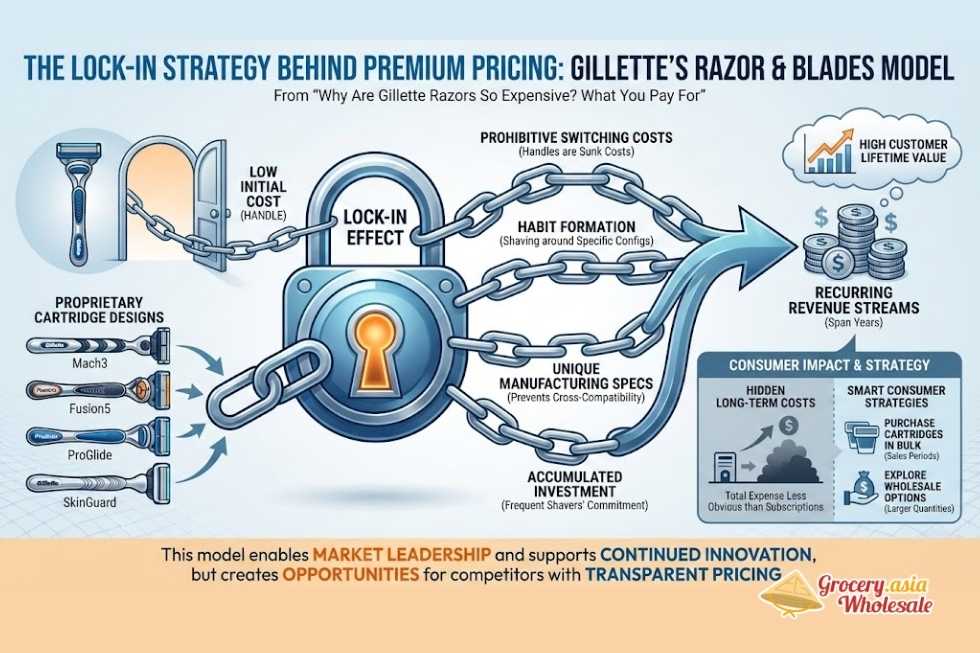
Gillette’s pricing model creates a powerful lock-in effect through proprietary cartridge designs. Each razor system – whether it’s the Mach3, Fusion5, ProGlide, or SkinGuard – uses cartridges that aren’t compatible with other brands or even different Gillette models. This incompatibility forces customers into a long-term relationship with their chosen razor system.
The lock-in strategy works particularly well because:
- Switching costs become prohibitive once you own a handle
- Customers develop shaving habits around specific blade configurations
- Manufacturing processes create unique cartridge specifications that prevent cross-compatibility
- Frequent shavers accumulate significant investments in their chosen system
This approach effectively transforms a one-time purchase decision into recurring revenue streams that span years. While competitors may offer compatible alternatives for some older models, Gillette consistently updates their systems to maintain proprietary advantages.
The razor and blades model also explains why Gillette invests heavily in marketing and product development. Each new customer acquisition represents potential lifetime value that extends far beyond the initial handle sale. The company can afford to subsidize razor handles because they recover costs through cartridge sales multiple times over.
I notice that this pricing strategy particularly impacts budget-conscious consumers who may be attracted to the low initial cost without fully understanding the long-term financial commitment. The supply chain complexities involved in producing these specialized cartridges also contribute to their premium pricing, as each system requires dedicated manufacturing processes and quality controls.
The hidden nature of this model’s true costs becomes apparent only after customers commit to a particular razor system. Unlike subscription services with transparent monthly fees, the razor and blades approach spreads costs across individual purchase decisions, making the total expense less obvious to consumers.
This business model has proven incredibly successful for Gillette, enabling them to maintain market leadership despite premium pricing. The recurring revenue from cartridge sales provides predictable cash flows that support continued innovation and aggressive marketing campaigns. However, it also creates opportunities for competitors who offer more transparent pricing or compatible alternatives.
Smart consumers can minimize these costs by purchasing cartridges in bulk during sales periods or exploring wholesale options for larger quantities. Understanding the razor and blades model helps explain not just why Gillette razors cost so much, but why the company structures its entire business around this pricing approach.
Marketing Millions: Building the “Best a Man Can Get” Brand
Procter & Gamble’s aggressive marketing strategy plays a crucial role in maintaining Gillette’s premium pricing structure. The company allocates over $8 billion annually on advertising across its entire brand portfolio, with Gillette receiving a significant portion of this investment. This massive financial commitment to marketing directly impacts the final cost consumers pay for Gillette products, as these expenses must be recovered through higher retail prices.
The legendary slogan “The Best a Man Can Get” exemplifies how strategic messaging creates perceived value that extends far beyond the physical product. This campaign doesn’t just promote razor functionality—it positions Gillette as an aspirational lifestyle choice. The psychological association between the brand and masculine excellence allows the company to command premium prices that competitors struggle to match.
Celebrity Partnerships and Global Sponsorships
Gillette’s partnership strategy with elite athletes and sports organizations creates powerful brand associations that resonate with target demographics. The following high-profile endorsements demonstrate the company’s commitment to building premium brand equity:
- NFL partnerships that connect the brand with America’s most popular sport
- Olympic Games sponsorships reaching global audiences during peak viewership periods
- Roger Federer endorsements linking the brand to tennis excellence and Swiss precision
- Tiger Woods partnerships associating Gillette with golf’s most recognizable figure
- David Beckham collaborations connecting the brand to international soccer stardom and style
These celebrity partnerships and sports sponsorships cost millions of dollars annually but create emotional connections that traditional product advertising cannot achieve. When consumers see their favorite athletes using Gillette products, they’re more willing to pay premium prices for the same perceived quality and status.
The emotional value creation through marketing transforms what could be viewed as a simple commodity into a luxury experience. I’ve observed that consumers often choose Gillette products not solely based on functional superiority but because of the brand’s carefully cultivated image of success, precision, and masculinity.
This marketing investment strategy creates a self-reinforcing cycle where higher prices fund more advertising, which strengthens brand perception, which justifies even higher prices. The complex supply chain that supports this premium brand positioning requires coordination between manufacturing facilities and marketing teams across multiple continents.
Gillette’s brand positioning extends beyond individual product promotion to encompass lifestyle marketing that influences consumer behavior at a subconscious level. The company’s advertising doesn’t just highlight razor features—it sells confidence, success, and social status. This psychological pricing strategy allows Gillette to maintain margins that would be impossible if consumers evaluated products based purely on functional specifications.
The integration of celebrity endorsements with major sporting events amplifies marketing impact while reaching diverse demographic segments. A single commercial featuring a celebrity athlete during a major sporting event can cost millions to produce and air, but the long-term brand value creation often justifies these investments through sustained premium pricing power.
Manufacturing locations in countries with lower labor costs, such as Vietnam export operations, help offset these substantial marketing expenses while maintaining profit margins. The balance between production efficiency and marketing investment creates the financial structure that supports Gillette’s premium pricing strategy.
Marketing expenses represent a fundamental component of product cost structure that directly influences retail pricing. Every television commercial, celebrity endorsement, and sporting event sponsorship adds to the overall expense base that must be recovered through consumer purchases. This reality means that choosing Gillette products involves paying not just for the razor itself, but for the entire marketing ecosystem that creates and maintains the brand’s premium positioning.

Market Domination: How Gillette Maintains Its Premium Pricing Power
Gillette’s pricing power stems from decades of strategic market positioning and brand building that competitors still struggle to match. Despite facing increased pressure from disruptive brands like Dollar Shave Club and Harry’s, the company maintains significant control over the shaving market through several key advantages.
Retail Dominance and Brand Recognition
I’ve observed how Gillette razors continue to command premium shelf space across major retailers, giving them unmatched visibility compared to newer entrants. As of 2022, Gillette and its women’s brand Venus held 44% of the U.S. razor and blades market, representing a decline from their previous dominance of around 70%. This shift reflects growing competition, yet the company’s market share remains substantial enough to justify premium pricing strategies.
The brand’s century-long presence has created deep consumer trust and recognition that competitors find difficult to replicate. Many customers associate Gillette with quality and reliability, making them willing to pay higher prices for what they perceive as superior products. This brand equity allows the company to maintain pricing power even when faced with more affordable alternatives.
Strategic Adaptation and Innovation Leadership
Recognizing the changing market dynamics, Gillette launched the Gillette Shave Club subscription model to compete directly with digital-first brands. This move demonstrates how the company adapts its supply chain and distribution strategies while maintaining premium positioning.
The company’s continued investment in research and development helps justify higher prices through product innovation. Features like:
- Multi-blade cartridges
- Precision trimmers
- Advanced lubrication strips
differentiate Gillette products from basic alternatives. These innovations, combined with extensive marketing campaigns, reinforce the perception that premium prices reflect superior value.
Distribution advantages also play a crucial role in Gillette’s pricing power. Their established relationships with major retailers and wholesale partners ensure product availability across diverse channels. This widespread availability means consumers often encounter Gillette products first, making them the default choice despite higher costs.
The company’s manufacturing scale enables them to invest in qualitative control and consistency that smaller competitors struggle to match. This reliability creates customer loyalty that supports premium pricing, as users prefer predictable performance over potential savings from untested alternatives.
Why Are Gillette Razors So Expensive: Are You Getting What You Pay For?
I’ve noticed that many consumers question whether Gillette’s premium pricing reflects genuine value. The answer lies in understanding how the company approaches product development and manufacturing. Gillette incorporates advanced engineering techniques and premium materials into every razor, creating a significant cost foundation that separates them from basic alternatives.
Advanced Engineering and Premium Materials Drive Costs
Products like the Fusion5 and ProGlide offer enhanced features and complexity compared to budget options. I can see how Gillette’s manufacturing process involves multiple precision components working together — from multi-blade cartridges to lubrication strips and ergonomic handles. Each element requires specialized materials that cost considerably more than standard alternatives.
Patents protect Gillette’s proprietary technologies, ensuring the company can maintain exclusivity on innovations like their blade geometry, coating formulations, and cartridge designs. This patent protection allows Gillette to charge premium prices without direct competition replicating their exact technologies. The research and development costs behind these patents also contribute to the final product price.
Manufacturing Precision Justifies Premium Pricing
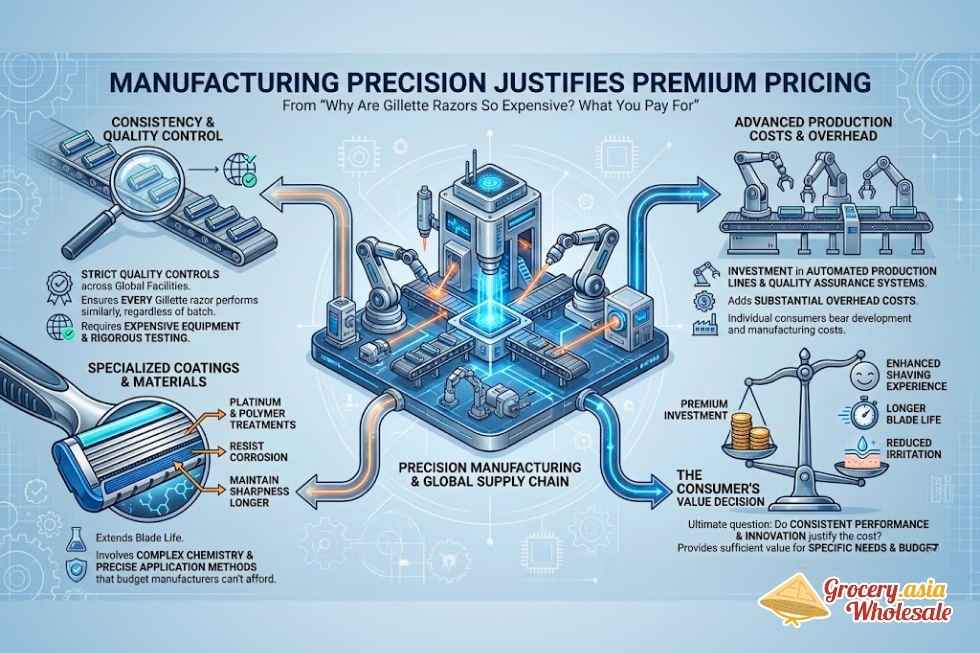
Precision manufacturing ensures product consistency, which explains why every Gillette razor performs similarly regardless of production batch. I’ve observed that Gillette’s supply chain maintains strict quality controls across their global facilities. This consistency requires expensive manufacturing equipment and rigorous testing protocols.
Specialized coatings help extend the life of each blade, incorporating materials like platinum and polymer treatments that resist corrosion and maintain sharpness longer. These coating processes involve complex chemistry and precise application methods that budget manufacturers typically can’t afford to implement.
The company’s investment in automated production lines and quality assurance systems adds substantial overhead costs. While wholesale pricing structures exist for bulk purchasers, individual consumers bear these development and manufacturing costs through retail pricing.
Ultimately, consumers must decide if the consistent performance and innovation justify the premium investment. I believe the question isn’t whether Gillette razors cost more — they clearly do — but whether the enhanced shaving experience, longer blade life, and reduced irritation provide sufficient value for your specific needs and budget.
Sources:
Fortune, “Inside Gillette’s Shaving ‘Space Race’ With Schick”
The New York Times, “How Many Blades Is Enough?”
Statista, “Market share of leading men’s razor and blade vendors”
Procter & Gamble Annual Reports

