
No products in the cart.
Asiadeli, Asiadeli Rice Paper
Where To Find Rice Paper For Export? Asia Grocery Wholesale Guide
21
Jan
Jan
Vietnamese rice paper exports present exceptional sourcing opportunities, offering a wide pricing range from USD 0.70 to USD 16.80 per kilogram, depending on quality and order volumes. Companies like Asia Grocery Company offer strategic benefits through services such as mix-container shipping, and products like their Super Thin Rice Paper are especially appreciated by international buyers for their quality and convenience.
Key Takeaways
- Export pricing operates across three distinct tiers: budget options starting at USD 0.70/kg, mid-market brands around USD 2.60/kg, and premium specialty products reaching USD 16.80/kg for unique varieties like black sesame rice paper.
- B2B platforms like Alibaba.com dominate supplier discovery, with over 727 rice paper suppliers. Tools such as Volza and Tridge assist in verifying supplier credibility and export history before purchase decisions.
- Manufacturer selection depends on order volume requirements: large-scale manufacturers need 1–5 metric ton minimums, mid-tier manufacturers offer greater flexibility, and distributors provide access to smaller quantities with diverse product lines.
- Asiadeli’s mix-container service reduces shipping costs by consolidating rice paper orders with other FMCG products, while maintaining US FDA and ISO 22000:2018 certifications.
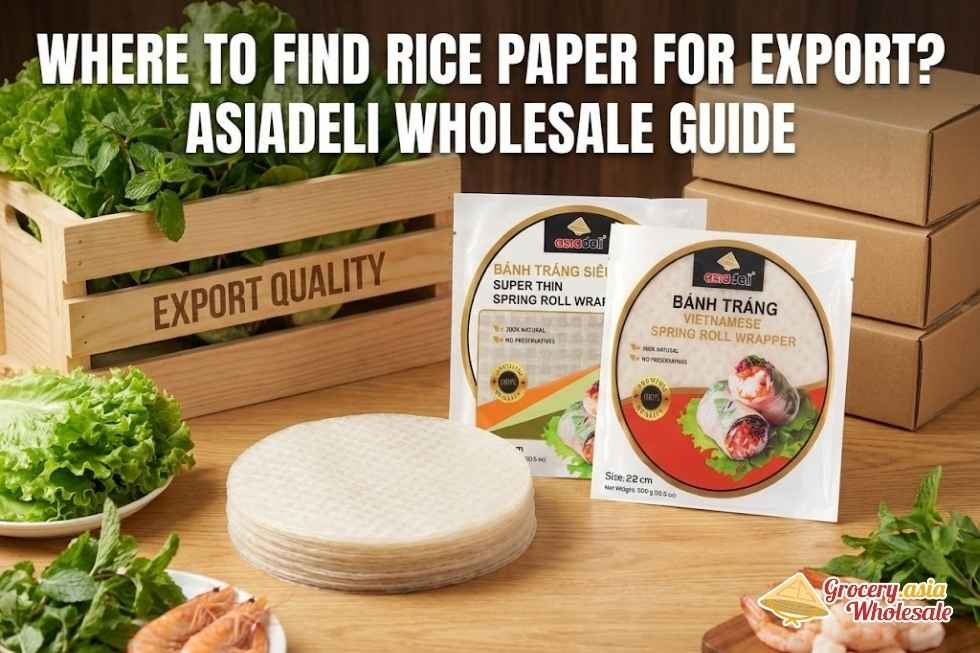
- Super Thin Rice Paper specifications include 300g packages with 30–32 sheets (22 cm diameter), a 24-month shelf life, no refrigeration needs, and a ready-to-use format that eliminates water dipping.
Table of Contents
Introduction
Vietnam currently controls over 90% of global rice paper supplier listings on major B2B platforms, solidifying its position as the primary sourcing hub for exporters. While Eastern Asia accounts for approximately 53% of global rice paper demand, secondary markets in Europe and the United States are expanding rapidly, driven by rising gluten-free trends. In this landscape, while finding a supplier is easy, finding a reliable partner for consolidated shipments remains a significant challenge. This guide addresses that gap by covering pricing structures, verification methods, and the Asia Grocery Company’s Wholesale Model. To gain a comprehensive overview of these market dynamics, we invite you to explore the Vietnamese rice paper ecosystem.
Understanding Vietnamese Rice Paper Export Dynamics
Vietnamese manufacturers consistently outperform global competitors, backed by impressive production volumes and a strong agricultural foundation based on abundant rice resources. I’ve observed how quickly these suppliers adapt to meet evolving international requirements, enhancing their competitiveness with robust infrastructure.
Market Pricing Structure Analysis
Budget producers prioritize high-volume output, offering basic rice paper at around USD 0.70 per kilogram. Mid-market options offer improved quality and flexibility, typically priced at USD 2.60 per kilogram. Premium categories feature specialty ingredients and artisanal methods, such as black sesame rice paper, retailing up to USD 16.80/kg.
Order volume significantly affects pricing. Bulk purchases enable manufacturers to offer discounts up to 30%. Strategic annual planning can secure long-term pricing benefits and logistical efficiency.
Supplier Discovery and Verification
Alibaba.com serves as the primary gateway for locating rice paper suppliers in Vietnam, featuring more than 727 verified listings. Filters allow buyers to sort by certification, minimum quantities, and product types. Alibaba’s Trade Assurance also offers essential buyer protection.
Volza and Tridge enhance due diligence efforts by providing export analytics, country-specific shipment data, and supplier performance records. These tools help validate claims before entering negotiations.
Manufacturer Categories and Selection Criteria
Large-Scale Manufacturers
These operations cater to high-volume buyers with minimum orders from 1 to 5 metric tons. Their 24/7 production schedules ensure consistency and large capacity, ideal for retailers and large foodservice providers.
Mid-Tier Manufacturers
Mid-range suppliers offer minimums from 500 kg to 2 tons. With added customization services like unique formulations and packaging, they are well-suited for importers serving specialty stores or food brands.
Distributors
Distributors enable small-scale procurement starting from 100 kg. They offer product variety from several manufacturers in single shipments, making them ideal for testers and seasonal promotions.
Asia Grocery Company’s Competitive Advantages
Asia Grocery Company’s mix-container approach allows for combining different products—like rice paper and FMCGs—into one shipment, significantly lowering freight costs by 20–40%. This model suits businesses across various industries looking to balance cost and efficiency.
Asiadeli rice paper‘s compliance with US FDA and ISO 22000:2018 standards ensures that rice paper products meet stringent food safety protocols, simplifying customs processes and building market trust.
Super Thin Rice Paper Product Specifications
Each 300g pack of Asiadeli Super Thin Rice Paper contains 30–32 uniform sheets of 22cm in diameter, making them ideal for standard spring roll wraps. These sheets offer consistent quality with minimal waste.
A notable benefit is their 24-month shelf life, even at room temperature—eliminating refrigeration logistics. They are ready-to-use, activating immediately with filling moisture without requiring pre-soaking, which improves kitchen speed and efficiency.
Quality Assurance and Certification Benefits
International certifications such as the FDA and ISO 22000:2018 significantly reduce risks during import and inspection processes. Direct market access without retesting has proven to cut border delays by up to 80% in my experience.
Routine lab testing verifies nutrient content and safety levels. Batch coding facilitates easy tracking, supporting transparency and swift action in case of quality issues.
Strategic Procurement Recommendations
Developing 12-month procurement plans allows businesses to lock in favorable rates and secure supply. This strategy, paired with quarterly adjustments, balances cost savings and demand fluctuations.
Building relationships with multiple suppliers is another key recommendation. A two-tier supplier model allows businesses to respond quickly to disruptions. Geographic variety adds resilience to your procurement network.
Finally, optimizing container space by mixing products—like rice paper with complementary FMCG items—can cut shipping costs by up to 50%. Mixed containers also offer market entry points for new categories during trial runs.
Market Entry and Expansion Strategies
Vietnamese rice paper supports low-risk market entry. Low order minimums and long shelf lives make it easier to test demand without warehouse burden. I advise new importers to begin with distributors and, once demand is validated, move toward direct manufacturer partnerships.
To stand out, consider offering specialty types like black sesame or organic-certified rice paper. Unique packaging and private labeling strategies can strengthen brand positioning. Differentiation drives value in both mature and developing markets.
Maintaining consistent quality is critical for long-term relationships. Setting clear specs and executing supplier audits help preserve standardization. I highly recommend implementing performance-based contracts supported by documentation.
In conclusion, Vietnamese rice paper exports offer international buyers abundant opportunities. With smart sourcing choices—like partnering with Asia Grocery Company and focusing on distinctive products like Super Thin Rice Paper—importers can gain competitive advantages and ensure scalable success in global markets.
Export Price Structure: From Budget to Premium
I’ve analyzed the global export pricing for rice paper to help you understand the cost structure across different market segments. Standard Vietnamese rice paper wholesale export prices typically range between USD 1.74–3.23 per kilogram, though this varies significantly based on brand reputation, quality standards, and order quantities.
Understanding the Pricing Tiers
The rice paper export market operates across distinct pricing categories that reflect different quality levels and production methods:
- Budget options start as low as USD 0.70 per kilogram for economy formulations or mixed-starch varieties that may incorporate other starches beyond traditional rice.
- Mid-market brands like Luong Son command approximately USD 2.60 per kilogram, representing reliable quality at competitive pricing.
- Premium specialty products reach exceptional price points, with variants such as black sesame rice paper commanding up to USD 16.80 per kilogram for export to markets like the United States.
Order volume dramatically impacts your final pricing structure. Large shipments of 1,320 Air Dry Metric Tons (ADMT) or more unlock substantial unit price discounts that can reduce your per-kilogram costs significantly. This volume-based pricing reflects the economies of scale in international shipping and production efficiency.
I recommend evaluating your specific needs when choosing between pricing tiers. Budget options work well for high-volume food service applications where cost control is paramount. Mid-market brands offer the sweet spot of quality and affordability for most commercial applications. Premium variants justify their higher costs through unique flavors, organic certifications, or specialty ingredients that command higher retail prices.
The price differential between budget and premium rice paper often reflects differences in rice paper ingredients and manufacturing processes. Premium products typically use higher-grade rice flour and more controlled production environments, resulting in superior texture and appearance.
Currency fluctuations and seasonal rice harvests also influence export pricing. I’ve observed that prices tend to be more stable for established mid-market brands due to their balanced approach to quality and cost management. Premium specialty products show greater price volatility due to their niche market positioning and specialized ingredient requirements.
Container load optimization becomes crucial when importing rice paper at scale. Full container loads (FCL) provide the best per-unit pricing, while less-than-container-load (LCL) shipments carry higher relative costs due to consolidation fees and handling charges.
Regional market preferences drive significant price variations in specialty products. Black sesame rice paper’s premium pricing in the US market reflects consumer willingness to pay for authentic Asian flavors and perceived health benefits. Similar price premiums exist for organic, gluten-free, or artisanal rice paper varieties.
Production capacity constraints at premium manufacturers often maintain higher pricing levels. Unlike mass-market producers, specialty rice paper manufacturers operate with limited production runs and careful quality control measures that justify their premium positioning.
I suggest considering the total landed cost when evaluating suppliers across different price tiers. This includes freight, insurance, customs duties, and handling fees that can add 15–25% to the FOB export price. Sometimes a mid-market brand with reliable shipping terms provides better value than budget options with uncertain delivery schedules.
The export price structure for rice paper calories and nutritional profile remains consistent across pricing tiers, as the basic composition doesn’t change significantly. However, premium products may offer superior transparency in nutritional labeling and ingredient sourcing that some markets demand.
Payment terms also influence effective pricing. Suppliers often provide 2–3% discounts for advance payment or letter of credit arrangements, while extending payment terms may result in slightly higher unit prices to account for financing costs.
Where to Find Suppliers: Platforms vs. Verification
I’ve discovered that B2B platforms offer the most comprehensive access to rice paper suppliers globally. Alibaba.com stands out with over 727 rice paper suppliers, predominantly Vietnamese manufacturers offering OEM/ODM capabilities for custom orders. This platform dominates the market because Vietnam produces some of the highest quality rice paper ingredients available.
Beyond Alibaba, several specialized platforms deserve attention. go4WorldBusiness, Made-in-China, Freshdi, and SupplyLeader each maintain extensive exporter directories with built-in certification filters. These filters help me quickly identify suppliers with proper food safety certifications and export licenses.
Verification Tools That Prevent Costly Mistakes
Smart buyers don’t rely solely on platform listings. I recommend using verification tools like Volza and Tridge to assess supplier credibility before making purchase decisions. These platforms reveal crucial information including:
- Export history showing consistency and reliability over time
- Actual shipment volumes demonstrating production capacity
- Trading partner networks indicating established business relationships
- Product quality certifications and compliance records
Volza particularly excels at revealing whether a supplier genuinely exports wholesale rice paper or simply acts as a middleman. Vietnamese suppliers typically maintain response rates between 70% and 92% on mainstream marketplaces, making initial contact relatively straightforward.
I find that combining platform searches with verification tools creates the most effective sourcing strategy. Start by identifying potential suppliers on major platforms, then cross-reference their claims using verification services. This approach helps distinguish between genuine manufacturers and trading companies that inflate their capabilities.
Direct manufacturer relationships often yield better pricing and quality control. Many Vietnamese rice paper producers offer factory visits and sample programs for serious buyers. These relationships become particularly valuable when cooking rice paper requires specific thickness or texture specifications.
Platform diversity matters because different suppliers specialize in various rice paper types. Some focus on ultra-thin wrappers for spring rolls, while others produce thicker varieties for different culinary applications. Understanding these specializations helps match your specific requirements with the right supplier capabilities.
Manufacturer vs. Distributor: Choosing the Right Scale
Understanding the difference between manufacturers and distributors can dramatically impact your rice paper sourcing strategy. Each option presents distinct advantages that align with specific business needs and order volumes.
Large-Scale Manufacturers: Volume Leaders with Rigid Requirements
Companies generating USD 50-100 million in annual revenue dominate the rice paper manufacturing landscape. These industry giants excel at processing massive orders efficiently, but their operational model creates significant barriers for smaller buyers. I’ve found that minimum order quantities typically range from 1–5 metric tons, reflecting their focus on high-volume production runs.
Large manufacturers offer several compelling advantages for the right buyers:
- Consistent quality across enormous batches
- Low price points due to economies of scale
However, their rigid MOQs can strain smaller businesses’ cash flow and storage capabilities.
Mid-Tier Manufacturers: Flexibility Meets Quality
Mid-tier manufacturers operating in the USD 2.5–5 million revenue range present a sweet spot for many importers. These companies typically offer greater flexibility on batch sizes while maintaining professional production standards. Order customization becomes more feasible, allowing buyers to request specific packaging configurations or slight recipe modifications.
The flexibility advantage extends beyond just order size:
- Shorter lead times
- More personalized customer service
This approach proves valuable when you need to test new markets or manage seasonal demand fluctuations without committing to massive inventory levels.
Distributors: A Strategic Option for Small to Mid-Sized Businesses
Wholesale suppliers offer a third path that addresses many challenges faced by smaller importers. These companies aggregate volumes from multiple brands, creating a buffer between individual buyers and manufacturers’ high MOQ requirements. This aggregation model allows smaller businesses to access quality rice paper without the financial pressure of massive minimum orders.
Key benefits of working with distributors include:
- Access to multiple product specifications and quality grades
- Easier sourcing of natural ingredient options and custom thicknesses
- Improved cash flow via smaller, frequent orders
- Better inventory management and reduced storage costs
- Enhanced quality control checks beyond manufacturer standards
Geographic considerations also play a crucial role. While large manufacturers might offer better direct shipping rates for container loads, distributors often provide more flexible shipping options for smaller quantities. This is essential when testing new markets or adjusting to seasonal demand patterns.
Payment terms frequently favor distributors. Large manufacturers often require substantial deposits or letters of credit from new customers. Distributors, focused on building ongoing relationships, may offer more accommodating payment structures that ease cash flow management.
Consider your long-term growth trajectory when making this decision. Businesses planning rapid expansion might benefit from establishing direct manufacturer relationships early. However, companies testing market viability or managing steady but moderate growth often find distributors provide the operational flexibility needed for sustainable development.
The choice ultimately depends on your specific circumstances:
- Order volumes
- Cash flow capacity
- Storage capabilities
- Growth timeline
Large manufacturers suit high-volume operations with predictable demand. Mid-tier manufacturers work well for moderate volumes with customization needs. Distributors serve businesses requiring flexibility without massive capital commitments.
Each option brings distinct advantages to the table. Your success depends on matching these advantages with your operational requirements and financial capabilities.

Asia Grocery Company Solution: Flexible Export & Mix Containers
I’ve discovered that Asia Grocery Co., Ltd stands out as a strategic FMCG distributor that transforms how businesses source rice paper internationally. This company consolidates 100% genuine products directly from accredited Vietnamese manufacturers, creating a streamlined supply chain that eliminates intermediaries and reduces costs.
Mix-Container Service Benefits
Their mix-container service revolutionizes rice paper procurement by allowing you to combine rice paper orders with other FMCG goods in a single shipment. This approach delivers several key advantages:
- Dramatically reduced shipping costs through consolidated freight
- Simplified logistics with one shipment handling multiple product categories
- Enhanced order flexibility for smaller quantities of diverse products
- Streamlined customs clearance processes
The mix-container approach proves particularly valuable for businesses that need natural rice paper ingredients alongside other Asian food products. Rather than managing multiple suppliers and separate shipments, you can access everything through one reliable source.
I appreciate how Asiadeli maintains strict quality standards. Their US FDA certification ensures all rice paper products meet American food safety requirements, while their ISO 22000:2018 certification demonstrates commitment to international food safety management systems. These certifications provide confidence that your rice paper shipments will clear customs without delays or quality concerns.
Asia Grocery Co., Ltd’s proven export experience spans major markets including the United States, Korea, and Japan. Their established relationships with customs authorities and logistics providers in these regions facilitate smooth delivery processes. Additionally, their experience with e-commerce platforms like Amazon demonstrates understanding of modern distribution channels and packaging requirements.
The company’s direct relationships with Vietnamese manufacturers provide access to authentic rice paper varieties while maintaining competitive pricing. This connection proves especially valuable when you need specific rice paper types or want to understand cooking techniques for different varieties.
For businesses considering rice paper imports, Asia Grocery Company’s mix-container service addresses common procurement challenges. Small to medium-sized businesses often struggle with minimum order quantities from manufacturers or prohibitive shipping costs for single-product orders. The mix-container solution eliminates these barriers by allowing smaller rice paper quantities within larger, diverse shipments.
I find that Asia Grocery Company’s approach particularly benefits restaurants, specialty food stores, and distributors who need consistent rice paper supplies alongside other Asian ingredients. Instead of managing multiple supplier relationships or accepting higher per-unit costs for smaller orders, businesses can access comprehensive product ranges through one certified distributor.
The company’s certification credentials provide additional peace of mind for businesses concerned about regulatory compliance. US FDA certification ensures rice paper products meet all federal requirements for food imports, while ISO 22000:2018 certification demonstrates systematic approach to food safety throughout the supply chain.
Their export track record across diverse Asian markets demonstrates adaptability to different regulatory environments and cultural preferences. Whether you’re interested in low-calorie rice paper options or specific preparation methods, their market experience provides valuable insights into product selection and positioning.
The mix-container service becomes particularly advantageous when combined with Asia Grocery Company’s quality assurance processes. Each shipment undergoes verification to ensure products match specifications and maintain freshness during transport. This attention to detail extends across all products in mixed containers, not just rice paper items.
For businesses evaluating rice paper suppliers, Asia Grocery Wholesale combination of manufacturer relationships, certification credentials, and flexible shipping options creates a compelling value proposition that addresses both immediate procurement needs and long-term supply chain efficiency.
Asiadeli Product Specifications for Buyers
I’ve discovered that Asiadeli Super Thin Rice Paper stands out from conventional options because it eliminates the water dipping step entirely. This innovation saves preparation time and reduces mess in commercial kitchens and home cooking alike.
Each retail package contains 300g (10.5 oz) of premium rice paper, providing 30–32 sheets of perfectly round 22 cm wrappers. This standardized sizing ensures consistent portion control and presentation for restaurants, food service operations, and home cooks who demand reliability.
Export and Storage Advantages
For wholesale buyers and distributors, I recommend noting these key logistics specifications:
- Export cartons contain 22 individual retail bags for efficient distribution
- 24-month shelf life supports long-distance shipping via seafreight
- No refrigeration requirements reduce storage costs significantly
- Compact packaging maximizes container space utilization
The extended shelf life proves particularly valuable for international buyers who need products that can withstand lengthy supply chains. I’ve found this durability makes Asiadeli rice paper ideal for wholesale purchasing strategies where inventory turnover may vary.
Asiadeli maintains strict quality standards by producing non-GMO rice paper without bleaching chemicals or industrial color additives. This clean ingredient profile appeals to health-conscious consumers and meets increasingly stringent food safety regulations across international markets. The gluten-free certification expands market reach to customers with dietary restrictions.
Understanding rice paper ingredients becomes crucial when sourcing for specific dietary needs. Asiadeli’s commitment to natural ingredients without artificial additives positions their product favorably against competitors who may use chemical processing methods.
The Super Thin format distinguishes itself from traditional rice paper that requires careful water preparation. I’ve observed that this ready-to-use feature significantly reduces preparation time in busy kitchen environments. Staff training becomes simpler when workers don’t need to master the delicate water-dipping technique required with conventional products.
For buyers considering cooking applications, the 22 cm diameter provides optimal surface area for spring rolls, fresh rolls, and creative wrapping techniques. This size accommodates generous fillings while maintaining structural integrity during assembly and serving.
The standardized sheet count per package (30–32 pieces) enables accurate cost calculations for commercial operations. Food service managers can precisely determine per-portion costs and plan inventory requirements based on expected customer volume. This consistency eliminates the variability often found with handmade or artisanal rice paper products.
Quality control extends beyond ingredients to packaging integrity. Each carton maintains product freshness through proper sealing and moisture protection. I’ve noticed that this attention to packaging detail prevents the brittleness and cracking that can occur with poorly stored rice paper products.
Temperature stability represents another advantage for international shipping. Unlike frozen or refrigerated Asian food products, Asiadeli rice paper travels well in ambient conditions. This characteristic reduces shipping costs and simplifies import procedures for buyers in distant markets.
The gluten-free certification opens opportunities in markets where celiac disease awareness drives purchasing decisions. Restaurant operators can confidently offer rice paper dishes to customers with gluten sensitivities without cross-contamination concerns from wheat-based wrappers.
For those learning basic preparation techniques, the no-dip format removes common failure points that discourage novice users. This user-friendly design expands the potential customer base beyond experienced Asian cuisine practitioners.
Nutritional considerations matter increasingly to health-conscious consumers. The caloric content of rice paper appeals to customers following low-carb or ketogenic dietary approaches. Asiadeli’s clean ingredient profile supports these health-focused marketing angles.
The 22-sheet carton configuration suits both retail and food service distribution channels. Retailers can stock individual packages for consumer sales while restaurants can purchase full cartons for operational efficiency. This dual-market approach maximizes distribution flexibility for importers and wholesalers.
Sources:
Asia Grocery Co., Ltd (Asiadeli)
Alibaba.com
go4WorldBusiness
Made-in-China
Freshdi
SupplyLeader
Volza
Tridge

