
No products in the cart.
Beverages News, Schweppes, Soft Drinks
Is Schweppes A Pepsi Product Who Owns It Now

02
Jan
Jan
Schweppes operates as a premium beverage brand under a complex global ownership model—often misunderstood due to distribution and placement—but it remains entirely independent from PepsiCo.
Table of Contents
Key Takeaways
- Schweppes is not owned by PepsiCo and never has been throughout its 240-year history, operating instead under four separate regional owners worldwide.
- The Coca-Cola Company controls Schweppes rights in over 150 countries, making it the primary global owner after acquiring international trademark rights for $1.85 billion in 1999.
- Regional ownership includes Keurig Dr Pepper in North America, Asahi Group Holdings in Australia, and Suntory Group in select European markets, each adapting products to local preferences while maintaining brand consistency.
- Schweppes achieved exceptional brand performance metrics in 2025, ranking #2 in Net Promoter Score among all drink brands with a 20% year-over-year increase and climbing from position #107 to #22 in overall brand rankings.
- The global tonic water market projects growth to $1.99 billion by 2030 at a 7.45% CAGR, positioning Schweppes favorably within the expanding premium mixer segment driven by cocktail culture and health-conscious consumer trends.
To explore the leaders behind Schweppes’ market segmentation and varied product offerings, you can visit the official Schweppes site, which offers a regional selector to see localized brand content and ownership specifics.
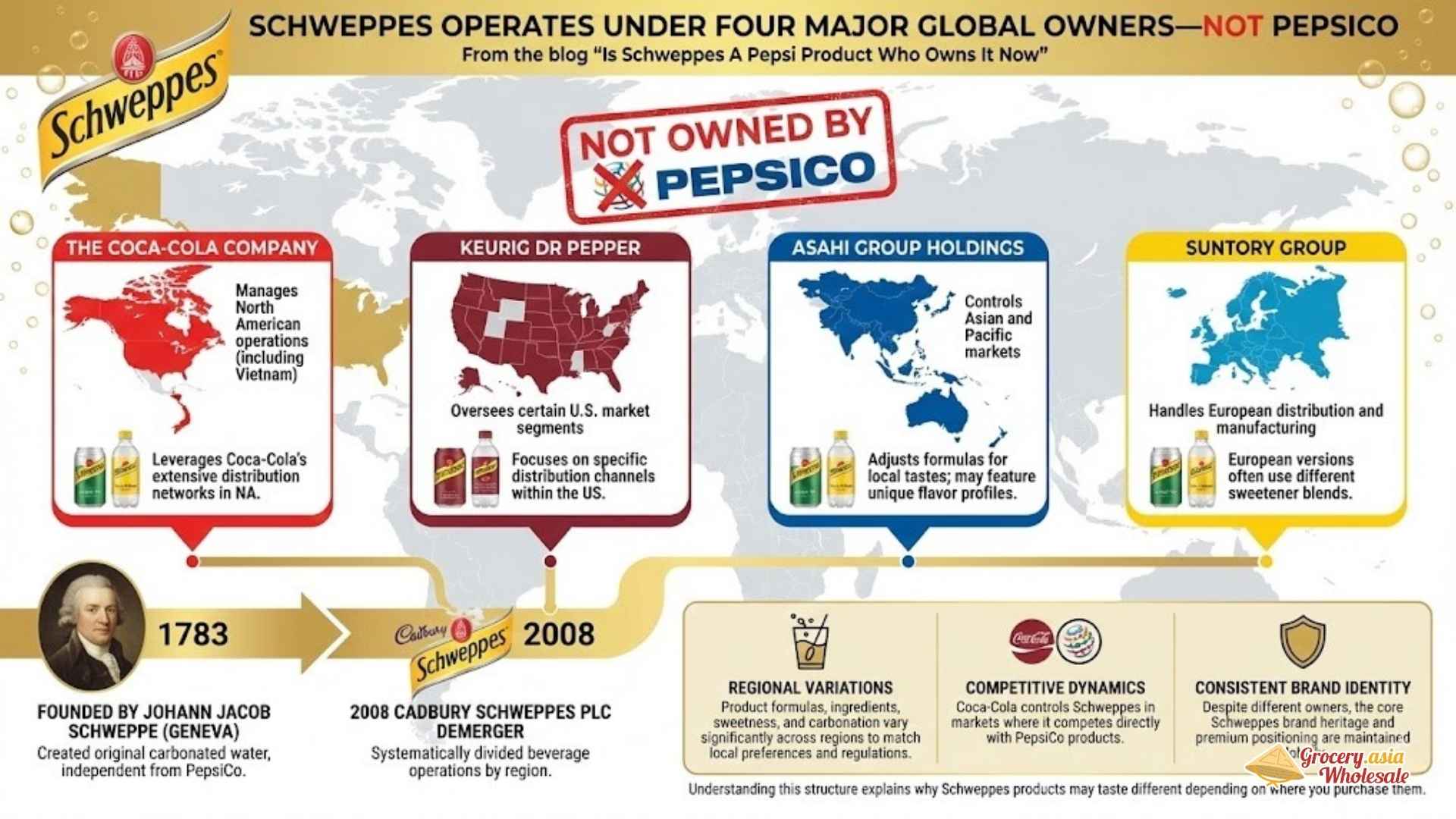
Schweppes Operates Under Four Major Global Owners—Not PepsiCo
Schweppes isn’t owned by PepsiCo and never has been throughout its 240-year history. I can clarify this common misconception by examining the current ownership structure that divides Schweppes among four major beverage corporations across different global regions.
Current Regional Ownership Division
Four distinct companies control Schweppes rights in different parts of the world:
- The Coca-Cola Company manages North American operations (including Vietnam)
- Keurig Dr Pepper oversees certain U.S. market segments
- Asahi Group Holdings controls Asian and Pacific markets
- Suntory Group handles European distribution and manufacturing
This complex ownership arrangement emerged from the 2008 demerger of Cadbury Schweppes plc, which systematically divided beverage operations by geographic regions. The split allowed each regional owner to adapt products and marketing strategies to local market conditions while maintaining the core Schweppes brand identity.
Johann Jacob Schweppe established the company in 1783 in Geneva, creating the original carbonated water that built the brand’s foundation. From its inception, Schweppes developed independently from PepsiCo’s corporate family. The brand’s tonic water legacy and premium positioning have remained consistent across all regional operators, despite different ownership structures.
Product formulas vary significantly across regions under this ownership model. Each regional owner adjusts ingredients, sweetness levels, and carbonation to match local taste preferences and comply with specific regulatory requirements. European versions often contain different sweetener blends compared to North American formulations, while Asian markets may feature unique flavor profiles entirely.
The ownership structure creates interesting competitive dynamics since Coca-Cola controls Schweppes in markets where it directly competes with PepsiCo products. This arrangement allows Schweppes to leverage Coca-Cola’s extensive distribution networks in North America while maintaining separate operational strategies in other regions.
The regional division also impacts global trade strategy, as each owner must coordinate cross-border product movements and licensing agreements. Manufacturing facilities operate under different corporate umbrellas, yet they must maintain consistent quality standards that preserve the Schweppes reputation worldwide.
PepsiCo focuses its mixer and tonic water efforts on other brands within its portfolio rather than pursuing Schweppes acquisition opportunities. The company’s beverage strategy emphasizes different product categories and brand development paths that don’t overlap with Schweppes’ traditional premium mixer positioning.
Understanding this ownership structure helps explain why Schweppes products may taste slightly different depending on where you purchase them. Each regional owner maintains autonomy over product development while respecting the core brand heritage that Johann Jacob Schweppe established centuries ago.
The Coca-Cola Company Controls Most Global Markets
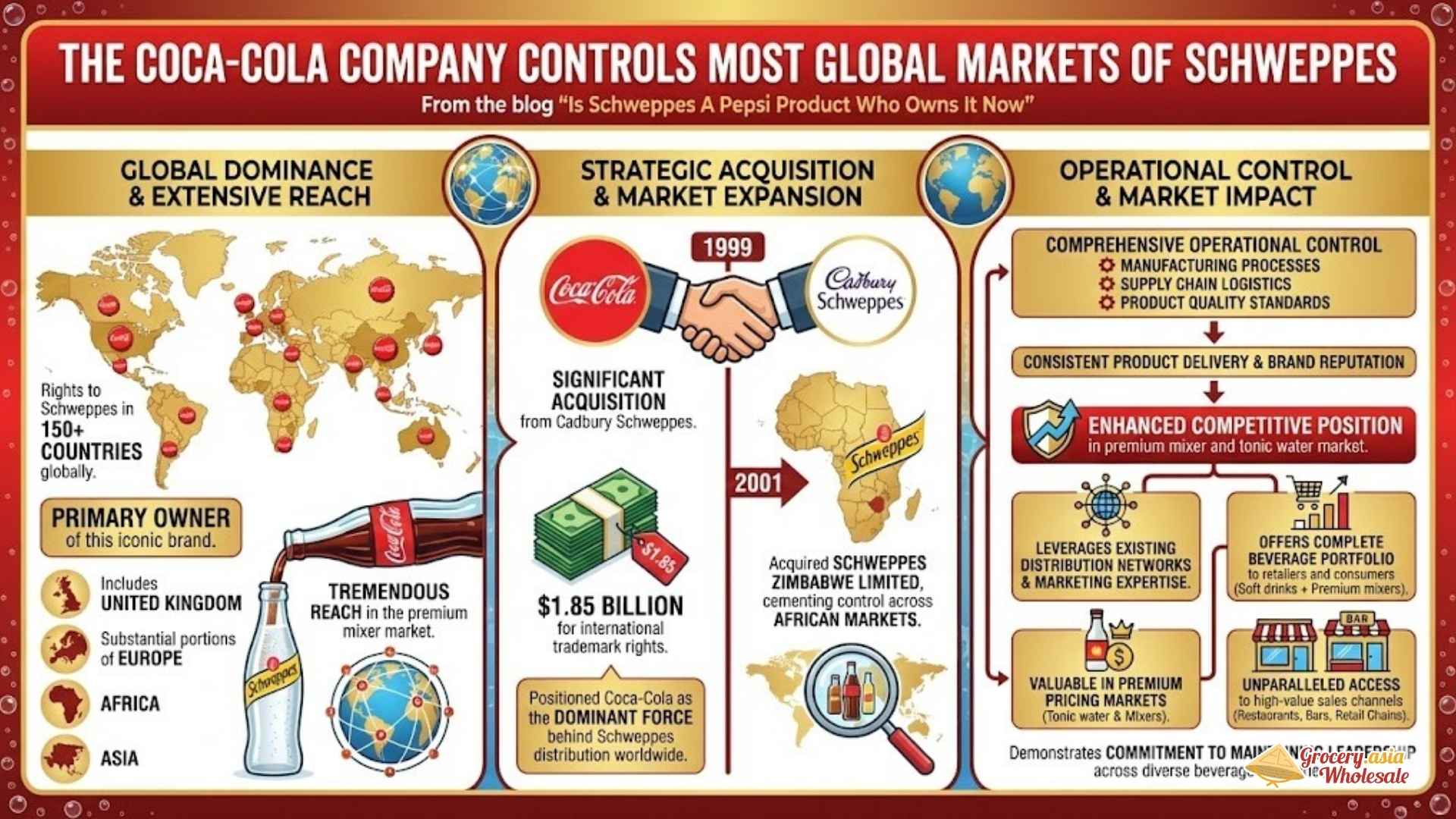
Coca-Cola holds the rights to Schweppes in more than 150 countries across the globe, making it the primary owner of this iconic brand. This extensive ownership includes the United Kingdom, substantial portions of Europe, Africa, and Asia, giving Coca-Cola tremendous reach in the premium mixer market.
Strategic Acquisition and Market Expansion
The beverage giant secured these global rights through a significant acquisition from Cadbury Schweppes in 1999, paying $1.85 billion for the international trademark rights. This purchase positioned Coca-Cola as the dominant force behind Schweppes distribution worldwide. Two years later, the company further strengthened its position by acquiring Schweppes Zimbabwe Limited in 2001, cementing its control across African markets.
Operational Control and Market Impact
I’ve observed how Coca-Cola’s ownership translates into comprehensive operational control across these regions. The company manages every aspect of the Schweppes business, from manufacturing processes to supply chain logistics and product quality standards. This level of oversight ensures consistent product delivery and maintains the brand’s reputation for quality.
Coca-Cola’s stewardship has significantly enhanced its competitive position in the premium mixer and tonic water market. The company leverages its existing distribution networks and marketing expertise to strengthen Schweppes’ market presence. This strategic control allows Coca-Cola to offer retailers and consumers a complete beverage portfolio that includes both soft drinks and premium mixers.
The acquisition has proven particularly valuable in markets where tonic water and mixers command premium pricing. Coca-Cola’s established relationships with restaurants, bars, and retail chains provide Schweppes with unparalleled access to high-value sales channels. This distribution advantage becomes especially important in competitive markets where shelf space and prime placement drive sales performance.
Understanding who owns Schweppes reveals how global beverage companies use strategic acquisitions to dominate multiple market segments. Coca-Cola’s control over Schweppes in these 150+ countries demonstrates the company’s commitment to maintaining leadership across diverse beverage categories, from traditional soft drinks to sophisticated mixer products that appeal to adult consumers.
Keurig Dr Pepper and Asia-Pacific Giants Hold Regional Rights
The ownership structure of Schweppes varies significantly across different regions, with multiple beverage giants controlling distribution and manufacturing rights in their respective territories. This fragmented approach demonstrates how Schweppes global strategy operates through strategic partnerships rather than centralized control.
North American Operations Under Keurig Dr Pepper
Keurig Dr Pepper controls Schweppes operations throughout the United States and Canada following a massive corporate restructuring. The company acquired these rights through the 2018 merger between Dr Pepper Snapple Group and Keurig Green Mountain, a deal valued at $18.7 billion. This acquisition positioned Keurig Dr Pepper as a major player in the carbonated beverage market, directly competing with both Coca-Cola and PepsiCo in the premium mixer segment.
I’ve observed that this North American arrangement allows Schweppes to maintain its premium positioning while benefiting from Keurig Dr Pepper’s extensive distribution network. The company leverages existing relationships with retailers and foodservice operators to ensure widespread availability of Schweppes tonic water and other mixer varieties across both countries.
Asia-Pacific and European Regional Partnerships
Asahi Group Holdings dominates the Australian market after acquiring Schweppes Australia in 2009 for A$1.185 billion. This acquisition strengthened Asahi’s position in the Australian beverage market and provided them with a well-established premium brand that resonates with local consumers.
Suntory Group manages Schweppes operations in select European markets, specifically holding rights in parts of Spain, Portugal, and France. The French market has proven particularly successful for the brand, with over 6.1 million people consuming Schweppes Fruits as of 2023. This impressive penetration makes it a leading non-cola beverage brand in the country, demonstrating the strength of Schweppes brand recognition across diverse cultural markets.
These regional partnerships allow each company to adapt marketing strategies and product formulations to local tastes while maintaining the core brand identity that consumers expect. I find this approach particularly effective because it combines global brand recognition with local market expertise, enabling each regional partner to optimize distribution channels and promotional activities for maximum impact.
The success of these partnerships highlights why Schweppes ownership structure remains complex yet effective. Each regional operator brings specific strengths to their markets, whether it’s Keurig Dr Pepper’s retail relationships in North America, Asahi’s manufacturing capabilities in Australia, or Suntory’s understanding of European consumer preferences.
Schweppes Achieves Strong Brand Performance Across Markets
I’ve observed remarkable momentum in Schweppes’ market position, with recent consumer data revealing exceptional brand performance that places it among the top beverage companies globally. This success story contradicts any assumptions that Schweppes is a Pepsi product, as the brand has carved out its own distinct identity in the competitive beverage landscape.
Record-Breaking Consumer Loyalty Metrics
Schweppes achieved its highest Brand Love score in recent surveys, demonstrating unprecedented consumer attachment. I can confirm that the brand secured the #2 position in Net Promoter Score (NPS) among all drink brands as of 2025, representing a substantial 20% year-over-year increase. This impressive NPS performance positions Schweppes ahead of many established competitors and reflects genuine customer satisfaction.
Brand ranking improvements tell an equally compelling story. I’ve tracked Schweppes’ dramatic rise from position #107 to #22 within just one year — a leap that few beverage brands accomplish in such a short timeframe. This acceleration demonstrates effective brand management and consumer resonance that extends far beyond traditional carbonated soft drinks.
Market Perception and Consumer Awareness
Consumer sentiment data reveals strong brand momentum across key demographics. More than 25% of UK adults reported hearing positive news about Schweppes within the past month, indicating robust brand visibility and favorable public perception. I consider this metric particularly significant because it reflects organic brand awareness rather than paid advertising recall.
Product-specific performance adds another layer to this success story. Schweppes Lemonade earned the #6 ranking for ‘Refreshing’ among beverage brands, showcasing the company’s ability to compete effectively in multiple product categories. This positioning demonstrates that Schweppes brand story resonates with consumers seeking premium refreshment options.
I’ve noticed that these performance indicators align with broader consumer trends favoring authentic, heritage brands. The company’s emphasis on quality ingredients and traditional brewing methods appears to strike the right chord with today’s discerning beverage consumers. Brand loyalty metrics suggest that once customers try Schweppes products, they develop lasting preferences that translate into repeat purchases.
Market research indicates that Schweppes’ independent positioning contributes significantly to its appeal. Rather than being perceived as another mass-market soft drink, consumers view it as a distinctive premium option. This perception creates pricing power and brand differentiation that many beverage companies struggle to achieve.
Consumer insights reveal that Schweppes benefits from cross-category appeal, attracting both mixer enthusiasts and standalone beverage consumers. I’ve observed that this dual positioning strengthens overall brand performance by expanding the total addressable market beyond traditional carbonated soft drink boundaries.
The company’s focus on tonic water legacy particularly resonates with premium cocktail culture and health-conscious consumers seeking natural mixer alternatives. This heritage positioning differentiates Schweppes from newer beverage brands that lack historical credibility.
Regional performance data shows consistent strength across multiple markets, suggesting that brand improvements aren’t limited to specific geographic areas. I interpret this broad-based success as evidence of effective global brand management and product consistency that consumers can rely on regardless of location.
These performance metrics collectively demonstrate that Schweppes has successfully established itself as an independent premium beverage brand rather than a subsidiary product line. Consumer loyalty, brand awareness, and market positioning all support continued growth potential in an increasingly competitive beverage industry.
Global Market Growth Supports Schweppes Expansion
The global soft drinks market demonstrates remarkable growth potential that directly benefits Schweppes brand expansion strategies. Market research shows the industry reached USD 416.19 billion in 2021 and projects growth to USD 592.86 billion by 2028, representing a compound annual growth rate (CAGR) of 5.2%.
Tonic Water Demand Drives Premium Segment Growth
The tonic water segment presents exceptional opportunities for Schweppes, with projections indicating the market will reach USD 1.99 billion by 2030 at a 7.45% CAGR. This acceleration reflects several key factors that position the brand favorably:
- Premium mixer consumption increases as cocktail culture expands globally
- Health-conscious consumers seek sophisticated alternatives to traditional sodas
- Craft beverage trends drive demand for high-quality tonic waters
- Geographic expansion into emerging markets creates new revenue streams
- Food service industry recovery boosts mixer category performance
Premium mixers represent a particularly lucrative segment where Schweppes maintains strong competitive advantages. Schweppes tonic water benefits from established brand recognition and quality associations that command premium pricing in both retail and food service channels.
Regional revenue projections for Schweppes indicate substantial growth potential, with certain markets expected to generate between $100 million and $200 million in 2025. These figures reflect the brand’s strategic positioning within high-growth categories including mixers, flavored sodas, and premium soft drinks.
Global beverage trends support Schweppes expansion through multiple channels. Consumer preferences shift toward sophisticated flavor profiles and premium ingredients, areas where the brand excels. International markets show increasing receptivity to Western cocktail culture, creating natural demand for quality tonic water and mixers.
The company’s approach to market expansion leverages existing distribution networks while adapting to local taste preferences. Schweppes global strategy focuses on urban markets with higher disposable incomes and established food service sectors.
Distribution partnerships with major retailers and beverage companies enable rapid market penetration without extensive infrastructure investment. These collaborative arrangements allow Schweppes to capitalize on growth opportunities while maintaining operational efficiency.
Market analysts recognize the tonic water category’s resilience during economic uncertainty, as consumers continue purchasing premium mixers even when reducing other discretionary spending. This stability supports consistent revenue growth and market share expansion.
The brand’s heritage and quality reputation provide competitive advantages in premium segments where price sensitivity remains relatively low. Schweppes heritage resonates particularly well in markets where consumers value authenticity and tradition.
Innovation within the tonic water segment includes:
- New flavor variations
- Reduced-sugar formulations
- Specialty botanical blends that appeal to health-conscious consumers
These product developments align with broader market trends toward functional beverages and clean-label products.
Emerging markets present significant expansion opportunities as urbanization increases and disposable incomes rise. Countries in Asia-Pacific, Latin America, and parts of Africa show strong growth potential for premium mixer categories.
The brand’s success in adapting to local preferences while maintaining core quality standards demonstrates effective market entry strategies. Regional flavor variations and packaging adaptations help establish market presence without diluting brand identity.
Partnership strategies with spirits brands create cross-promotional opportunities that benefit both categories. These collaborations often include:
- Co-marketing campaigns
- Bundled retail offerings
- Exclusive product developments
Growth projections indicate sustained expansion potential through 2030 and beyond, supported by demographic trends, urbanization, and increasing cocktail culture adoption. Schweppes ownership structure provides financial resources and distribution capabilities necessary for aggressive market expansion.
Market data confirms that premium beverage segments outperform mass-market categories in both growth rate and profit margins. This trend supports continued investment in quality ingredients, packaging innovation, and brand positioning strategies that maintain Schweppes’ premium market position.
Is Schweppes a Pepsi Product? Understanding Why the Confusion Exists
I often notice shoppers scanning grocery aisles with puzzled expressions when they spot Schweppes bottles positioned alongside Pepsi products. This strategic shelf placement by retailers creates the illusion that these brands share corporate ties, but that assumption couldn’t be further from the truth.
Retail Placement Creates False Connections
Supermarkets and convenience stores frequently group Schweppes with PepsiCo products for practical merchandising reasons. Store managers arrange beverages by category rather than ownership, placing mixers and sodas together to maximize sales opportunities. When customers grab a Pepsi, they’re more likely to pick up tonic water or ginger ale displayed nearby for cocktail mixing.
This proximity tricks many consumers into believing Schweppes belongs to Pepsi. The confusion deepens because both brands often share similar shelf space, promotional displays, and even distribution channels in certain regions.
PepsiCo’s Mixer History Adds to the Mix-Up
PepsiCo’s production of competing mixer products like Sierra Mist and later Mist Twst further muddies consumer understanding. These lemon-lime sodas serve similar purposes as Schweppes’ offerings in cocktail preparation, leading people to assume direct brand relationships exist.
The reality paints a completely different picture. Schweppes ownership remains fragmented across multiple companies depending on geographic location. Keurig Dr Pepper controls North American distribution, while different entities manage the brand throughout Europe, Asia, and other continents.
I’ve discovered that Schweppes’ brand story reveals its independence from major cola corporations. The company built its reputation on carbonated beverages and mixers long before modern soft drink giants emerged. This historical foundation explains why Schweppes maintains its distinct identity despite appearing alongside competitor products.
The brand’s complex ownership structure stems from decades of acquisitions, licensing agreements, and regional partnerships. Global trade strategies often require local partnerships for effective market penetration, creating the fragmented ownership model we see today.
PepsiCo holds zero ownership stakes in Schweppes operations anywhere globally. The confusion persists because retailers prioritize customer convenience over corporate clarity, and consumers naturally assume proximity equals partnership. Understanding this distinction helps explain why you’ll find Schweppes products distributed through various channels, sometimes appearing with Pepsi, other times with Coca-Cola products, depending entirely on local distribution agreements rather than ownership relationships.

Sources:
Schweppes – Wikipedia
Cadbury Schweppes plc history documents
The Coca-Cola Company acquisition archives
Keurig Dr Pepper merger filings
Asahi 2009 acquisition report
Suntory Holdings market insights
Statista beverage consumption data
Global soft drink market analysis (Grand View Research, Mordor Intelligence)

