
No products in the cart.
For men, Gillette, Personal Care News
Who Is The Owner Of Gillette Razors Corporate Roots
06
Dec
Dec
The Procter & Gamble Company (P&G) owns Gillette razors today, having acquired The Gillette Company in 2005 through a landmark $57 billion deal that transformed the consumer goods industry. This acquisition brought together King Camp Gillette’s revolutionary safety razor innovation from 1901 with P&G’s global manufacturing and distribution capabilities, creating one of the most successful brand ownership structures in personal care products.
Table of Contents
Key Takeaways
- P&G officially owns Gillette razors after acquiring The Gillette Company in 2005 for $57 billion, marking the largest consumer goods merger in history.
- Gillette operates within P&G’s Grooming business segment, which generated $6.4 billion in net sales during fiscal year 2023 and contributed significantly to P&G’s $82 billion total revenue.
- King Camp Gillette founded the company in 1901 and revolutionized shaving with his patented safety razor design, pioneering the razor-and-blades business model still used today.
- P&G’s ownership provides Gillette with advanced R&D capabilities, global distribution networks reaching over 180 countries, substantial marketing budgets, and manufacturing expertise.
- Gillette maintains over 50% of the global razor and blades market through P&G’s comprehensive product portfolio, technical innovation, and extensive retail presence despite competition from direct-to-consumer brands.
For more information about Procter & Gamble and its product lines, you can visit the official P&G website.
Who Is the Owner of Gillette Razors?
I can tell you that The Procter & Gamble Company (P&G) owns Gillette razors today. This multinational consumer goods corporation, headquartered in Cincinnati, Ohio, officially acquired The Gillette Company in 2005 through a landmark corporate deal that reshaped the grooming industry.
P&G’s acquisition of Gillette marked one of the most significant mergers in consumer goods history. The deal brought together two industry giants, with P&G gaining control of Gillette’s extensive razor and blade portfolio along with its global manufacturing network. Since the acquisition, Gillette’s supply chain has been integrated into P&G’s broader operational framework.
Gillette’s Position Within P&G
Gillette operates as a key brand within P&G’s Grooming business segment, which also includes Venus razors for women and Braun electric shavers. This segment generated $6.4 billion in net sales during fiscal year 2023, contributing significantly to P&G’s total global revenue of $82 billion. The strong performance demonstrates Gillette’s continued value as a cornerstone of P&G’s portfolio.
The ownership structure allows Gillette to benefit from P&G’s extensive resources, including:
- Advanced research and development capabilities across multiple product categories
- Global distribution networks that reach consumers in over 180 countries
- Substantial marketing budgets that support brand visibility and innovation
- Manufacturing expertise that enables efficient production scaling
P&G’s ownership has enabled Gillette to maintain its position as a market leader while expanding into new technologies and markets. The company leverages P&G’s global infrastructure to ensure consistent product availability and quality control. Gillette’s manufacturing facilities operate under P&G’s quality standards, ensuring products meet the same specifications whether produced in the United States, Europe, or Asia.
The acquisition has also allowed Gillette to benefit from P&G’s innovation pipeline. New product developments now receive support from P&G’s broader research teams, leading to advances in blade technology, handle ergonomics, and shaving cream formulations. This collaborative approach has helped maintain Gillette’s competitive edge against emerging brands and private label alternatives.
P&G’s financial strength provides Gillette with the stability needed to invest in long-term growth initiatives. The parent company’s diverse portfolio, which includes household names like Tide, Pampers, and Crest, creates financial resilience that supports continued investment in the Gillette brand. This backing has proven particularly valuable during economic uncertainties and supply chain challenges.
The ownership arrangement has facilitated Gillette’s expansion into emerging markets, where P&G’s established presence provides valuable distribution channels and market knowledge. Vietnam export operations exemplify how P&G’s global reach has enhanced Gillette’s international presence.
For retailers and distributors interested in Gillette wholesale opportunities, P&G’s ownership structure provides clear contact points and standardized business processes. The company’s established trade relationships and volume commitments create predictable supply arrangements that benefit business partners.
P&G’s stewardship has maintained Gillette’s reputation for quality while adapting to changing consumer preferences. The parent company’s consumer research capabilities help identify trends and opportunities that inform product development decisions. This data-driven approach has supported successful launches like Gillette’s heated razor technology and subscription services.
Today’s Gillette reflects both its heritage as an independent innovation leader and its evolution under P&G ownership. The brand continues to hold significant market share in the global razor category while benefiting from the resources and expertise that come with being part of one of the world’s largest consumer goods companies. This ownership structure positions Gillette to respond effectively to competitive pressures while maintaining its focus on delivering superior shaving experiences to consumers worldwide.
The $57 Billion Deal That Transformed the Consumer Goods Industry
On January 28, 2005, Procter & Gamble announced its intention to acquire The Gillette Company in what became the most significant corporate merger in consumer goods history. This $57 billion deal marked P&G’s largest acquisition ever and fundamentally reshaped the landscape of personal care products globally.
Strategic Alliance and Industry Support
The merger brought together two industry powerhouses with complementary strengths. P&G’s established dominance in household and personal-care products aligned perfectly with Gillette’s commanding position in male grooming. Berkshire Hathaway, which held one of the largest stakes in Gillette at the time, threw its full support behind the acquisition. Warren Buffett characterized the deal as “a dream,” highlighting the strategic value both companies would gain from combining their operations.
This wasn’t simply about adding another brand to P&G’s portfolio. The acquisition delivered immediate access to Gillette’s premium male grooming portfolio while also bringing Duracell batteries, Braun small appliances, and Oral-B dental care products under P&G’s corporate umbrella. Each of these brands maintained strong market positions in their respective categories, creating instant diversification benefits for P&G’s overall business strategy.
Operational Advantages and Global Expansion
The merger provided Gillette with several critical advantages that transformed its ability to compete globally. Access to P&G’s extensive distribution network opened new markets and strengthened existing retail relationships. This infrastructure proved particularly valuable for international expansion efforts and helped streamline the complex logistics of reaching consumers worldwide.
P&G’s advanced research and development capabilities enhanced Gillette’s innovation potential significantly. The combined R&D resources allowed for faster product development cycles and more sophisticated technology integration across all product lines. Manufacturing efficiency also improved through shared expertise, with production facilities benefiting from P&G’s operational excellence standards.
Marketing resources expanded dramatically for Gillette brands following the acquisition. P&G’s global advertising reach and consumer insights capabilities provided Gillette with tools to better understand market preferences and develop more targeted campaigns. This enhanced marketing power proved especially valuable in emerging markets where brand awareness required substantial investment.
The deal created immediate synergies across multiple business functions:
- Supply chain optimization reduced costs through consolidated purchasing power and shared vendor relationships.
- Administrative functions streamlined operations while maintaining the distinct brand identities that consumers recognized and trusted.
Financial markets responded positively to the strategic rationale behind the merger. Analysts recognized that combining P&G’s broad consumer goods expertise with Gillette’s focused grooming leadership would create competitive advantages neither company could achieve independently. The transaction structure, which included both cash and stock components, demonstrated confidence from both organizations about the long-term value creation potential.
This acquisition represented more than a simple corporate transaction. It established a new template for how major consumer goods companies could expand their market presence through strategic acquisitions. The successful integration of Gillette’s operations with P&G’s existing business model proved that large-scale mergers could deliver promised synergies without disrupting core brand equity.
The transformation extended beyond immediate operational benefits. P&G’s global presence accelerated Gillette’s expansion into emerging markets where shaving culture was evolving. Countries across Asia, Latin America, and Africa became priority markets for Gillette’s supply chain expansion, supported by P&G’s established distribution partnerships.
Today, this historic merger continues to influence how Gillette operates within P&G’s portfolio. The brand maintains its distinct identity while leveraging the operational scale and global reach that only a company of P&G’s size can provide. This combination has enabled Gillette to remain competitive in an increasingly crowded personal care market while continuing to innovate across its product lines.
King Camp Gillette: The Inventor Who Revolutionized Modern Shaving
King Camp Gillette stands as the visionary founder behind one of the most recognizable names in personal grooming. This American inventor and salesman fundamentally transformed how men approach their daily shaving routine, creating a legacy that extends far beyond his initial breakthrough.
The Birth of an Innovation
I find it fascinating that Gillette’s revolutionary idea first struck him in 1895. His inspiration centered on creating a disposable razor blade — a concept that seemed almost impossible at the time. Traditional straight razors dominated the market, requiring constant maintenance and posing significant safety risks for everyday users.
Gillette’s breakthrough lay in developing a thin, inexpensive steel blade that could be sharpened mechanically and simply discarded after use. This innovation addressed two critical problems: the danger associated with straight razors and the inconvenience of constant blade maintenance. His vision went beyond just creating a better razor; he imagined a completely new business model based on disposable components.
Engineering Excellence and Patent Success
The transformation from concept to reality required exceptional engineering expertise. Gillette partnered with William Emery Nickerson, an MIT-trained machinist who possessed the technical skills necessary to bring this ambitious project to life. Nickerson’s engineering background proved essential in developing the manufacturing processes needed for mass production.
Their collaboration resulted in several key innovations that made the safety razor commercially viable:
- Development of precise manufacturing techniques for thin steel blades
- Creation of a protective guard system that prevented cuts while maintaining effectiveness
- Engineering of a handle design that provided optimal control and comfort
- Implementation of mass production methods that kept costs affordable
The culmination of their efforts achieved official recognition on November 15, 1904, when U.S. Patent No. 775,134 was granted for the Gillette safety razor. This patent protected their revolutionary design and established the foundation for what would become a global empire.
The impact of Gillette’s invention extended far beyond personal convenience. His safety razor offered a genuinely safer alternative to straight razors, reducing the risk of serious cuts and making daily shaving accessible to a broader population. The disposable blade concept also introduced an entirely new revenue model that companies across various industries would later adopt.
Understanding where Gillette razors are manufactured today reveals how King Camp Gillette’s original vision has expanded globally. Modern production facilities continue to build upon his foundational principles while incorporating advanced manufacturing technologies.
King Camp Gillette’s story demonstrates how a single innovative idea, combined with skilled engineering and strategic partnerships, can reshape entire industries. His collaboration with Nickerson proved that successful invention requires both creative vision and technical expertise. The safety razor didn’t just improve existing technology; it created an entirely new category of products that prioritized user safety and convenience.
The disposable blade concept that Gillette pioneered became a template for countless other products. His business model of selling an initial device at a low profit margin while generating ongoing revenue through replacement components influenced industries ranging from printers to gaming consoles.
Today’s Gillette supply chain reflects the global scale that emerged from King Camp Gillette’s original Boston-based operation. His invention not only changed personal grooming habits but also demonstrated how innovative thinking could create lasting commercial success through practical problem-solving.
From Humble Beginnings to Global Market Domination
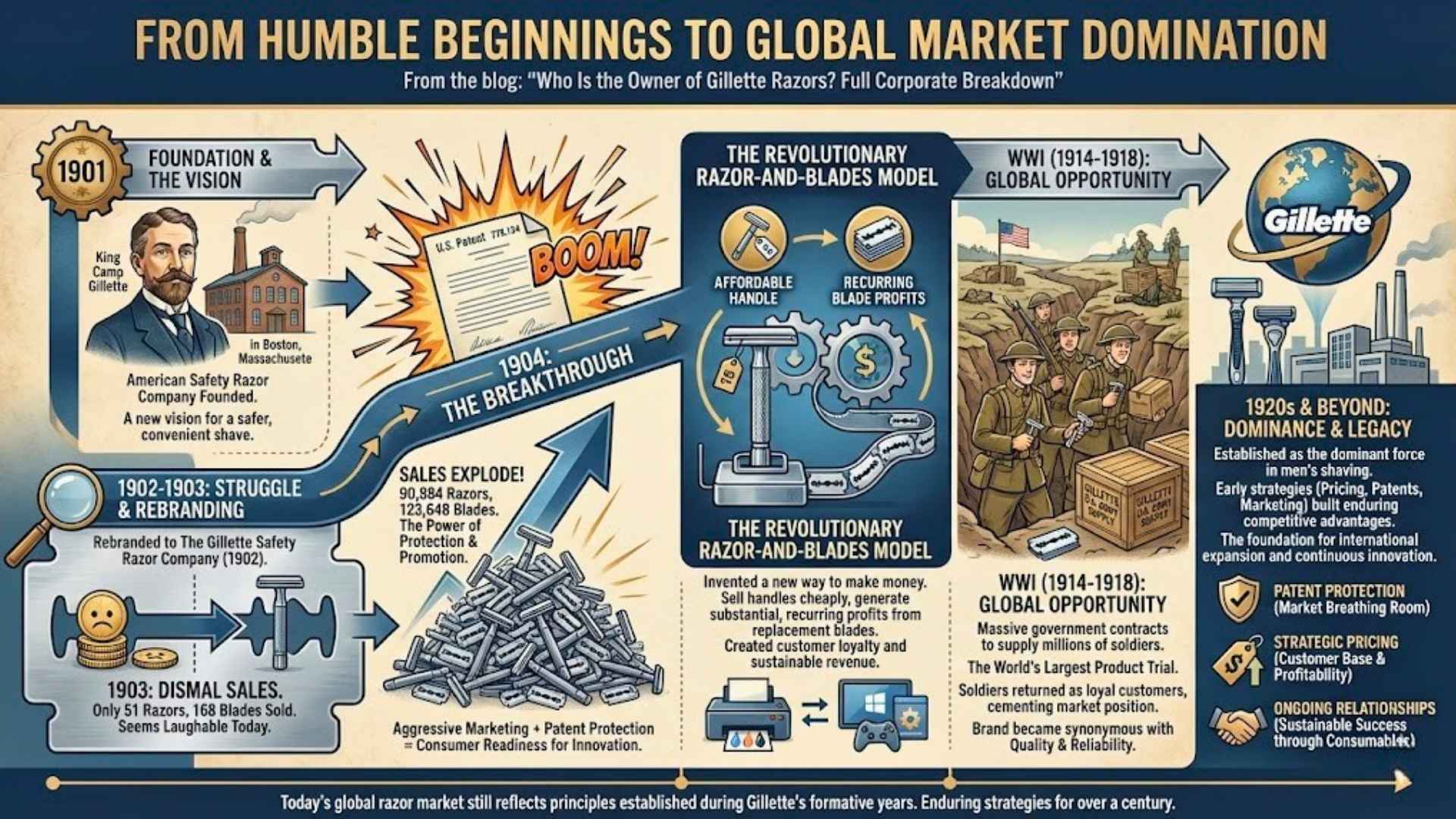
King Camp Gillette’s revolutionary idea took shape in 1901 when he established the American Safety Razor Company in Boston, Massachusetts. I find it fascinating that this company would transform into one of history’s most recognizable brands, though success didn’t come immediately.
Early Struggles and Breakthrough Success
The company rebranded as The Gillette Safety Razor Company in 1902, but initial sales figures tell a story of humble beginnings. During 1903, Gillette managed to sell only 51 razors and 168 blades—numbers that pale in comparison to today’s massive production volumes. However, everything changed dramatically after U.S. Patent 775,134 received approval and the company launched aggressive marketing campaigns.
The transformation was remarkable. Sales exploded in 1904, reaching 90,884 razors and an impressive 123,648 blades. This surge demonstrated the market’s appetite for Gillette’s innovative safety razor design, which offered a safer alternative to traditional straight razors.
Revolutionary Business Model and Strategic Growth
Gillette pioneered what became known as the razor-and-blades business model, a strategy that countless companies still employ today. The concept was brilliantly simple:
- Sell the razor handles at affordable prices
- Generate substantial profits through replacement blade sales
- Create recurring revenue streams and build customer loyalty
World War I presented an unprecedented opportunity that would cement Gillette’s position in American culture. The company secured contracts to supply razors to millions of American soldiers, creating an entire generation of loyal customers. These soldiers returned home with established shaving habits and brand preferences, providing Gillette with a massive consumer base that would drive growth for decades.
The Gillette supply chain that supports today’s global operations traces its roots back to these early manufacturing decisions and distribution strategies. The company’s ability to scale production efficiently during wartime demonstrated the strength of its operational foundation.
Understanding where Gillette razors are made today reveals how far the company has expanded from its Boston origins. Modern production facilities span multiple continents, reflecting the global reach that began with King Camp Gillette’s original vision.
The strategic importance of military contracts extended beyond immediate sales figures. These partnerships established Gillette as a trusted brand capable of meeting large-scale demands while maintaining quality standards. The psychological impact of government endorsement through military procurement added credibility that civilian marketing campaigns alone couldn’t achieve.
Gillette’s early marketing efforts focused heavily on educating consumers about safety razor benefits compared to traditional shaving methods. The company invested significantly in advertising campaigns that:
- Explained proper usage techniques
- Emphasized the convenience of disposable blades
This educational approach helped overcome consumer resistance to adopting new technology.
The razor-and-blades model’s success depended on consistent blade quality and availability. Gillette invested heavily in manufacturing capabilities and distribution networks to ensure customers could easily purchase replacement blades. This focus on accessibility and reliability became a cornerstone of the company’s competitive advantage.
The transition from American Safety Razor Company to The Gillette Safety Razor Company reflected King Camp Gillette’s growing confidence in his product and brand vision. Personal branding played a crucial role in establishing consumer trust, with Gillette’s own image and story becoming integral to the company’s marketing narrative.
The dramatic sales increase between 1903 and 1904 highlighted the importance of patent protection in establishing market position. Once legal protections were secure, Gillette could invest aggressively in marketing and production without fear of immediate competition copying their innovations.
Today’s Gillette wholesale operations reflect the distribution expertise that began developing during these formative years. The company learned early that controlling supply chains and maintaining consistent product availability was essential for building lasting market dominance.
How Gillette Maintains Global Leadership in the Grooming Industry
P&G’s strategic ownership of Gillette has created a comprehensive grooming ecosystem that extends far beyond traditional razors. The company positions Gillette as its flagship brand within the Grooming segment, supported by complementary products that address diverse consumer needs across multiple categories.
Comprehensive Product Portfolio Strategy
Gillette’s dominance stems from P&G’s diverse brand portfolio that covers every aspect of the grooming market. I’ve observed how the company strategically positions different product lines to capture various consumer segments:
- Men’s blades and razors feature premium options like Fusion5 and ProGlide for performance-focused users
- SkinGuard targets men with sensitive skin concerns
- Mach3 serves as the reliable mid-tier option
- Venus addresses the women’s shaving market with specialized designs
- Braun electric grooming tools complement traditional wet shaving
- The Art of Shaving caters to luxury consumers seeking premium experiences
This tiered brand strategy allows P&G to compete across price points while maintaining Gillette’s premium positioning. Each product line targets specific demographics and usage occasions, creating multiple touchpoints with consumers throughout their grooming journey.
Market Dominance Through Innovation and Distribution
Gillette maintains over 50% of the global razor and blades market despite increased competition from direct-to-consumer brands. Dollar Shave Club and Harry’s have certainly challenged traditional pricing models, but Gillette’s competitive advantages remain formidable.
P&G’s substantial R&D investment keeps Gillette at the forefront of shaving technology. Patented innovations like FlexBall technology demonstrate the company’s commitment to continuous improvement. The development of 5-blade cartridges and advanced lubrication enhancements showcases how Gillette razors are made with cutting-edge engineering that competitors struggle to match.
The company’s worldwide retail presence provides unmatched distribution advantages. I’ve noticed that Gillette products are available in virtually every major retailer globally, from premium department stores to convenience shops. This extensive reach, combined with decades of brand equity, creates significant barriers for new entrants.
Strong brand recognition continues to drive consumer loyalty despite price competition. P&G leverages this equity through consistent marketing campaigns and strategic partnerships with professional athletes and influencers. The company’s ability to command premium pricing reflects consumer confidence in Gillette’s quality and performance.
P&G’s integrated approach to the grooming market positions Gillette for continued leadership. The company’s supply chain capabilities ensure consistent product availability while maintaining quality standards across diverse markets. Manufacturing facilities strategically located worldwide enable efficient distribution and cost management.
Technical superiority remains Gillette’s core competitive advantage. The brand’s focus on precision engineering and ergonomic design creates products that deliver superior shaving experiences. P&G’s research facilities continuously develop new blade technologies, handle materials, and comfort features that maintain Gillette’s performance edge.
The company’s multi-channel strategy adapts to changing consumer preferences while preserving traditional retail relationships. P&G has successfully launched direct-to-consumer options and subscription services that compete with disruptive brands while protecting existing distribution partnerships.
Market data consistently shows Gillette’s resilience against competitive pressure. The brand’s ability to maintain premium positioning while defending market share demonstrates P&G’s effective ownership strategy. Innovation cycles, brand management, and distribution excellence create a sustainable competitive moat that protects Gillette’s leadership position in the global grooming industry.
Sources:
Procter & Gamble: 2023 Annual Report
The New York Times: “Procter & Gamble Buys Gillette”
Harvard Business School: “Finding New Play in a Commoditized Market”
Associated Press: “Buffett Calls P&G–Gillette Deal a ‘Dream’”
U.S. Patent and Trademark Office: Patent No. 775,134

